2021 H2 Chem P1 Q22 — Nitrogen Compound Solution
Question
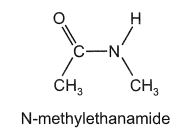
Which statements can be used to explain why an aqueous solution of N-methylethanamide has no effect on red litmus?
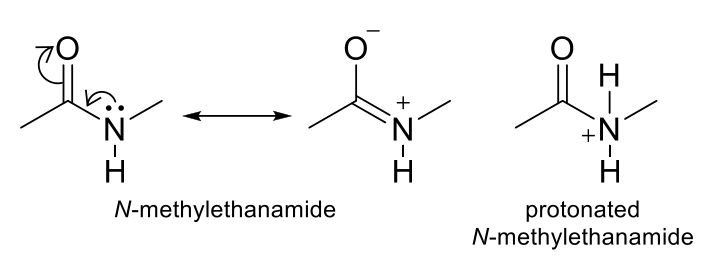
1 Delocalisation of the lone pair of electrons on the nitrogen atom over the C=O group results in the nitrogen becoming less available for protonation.
2 Delocalisation of the lone pair of electrons on the nitrogen atom over the C=O group strengthens the C–N bond.
3 N-methylethanamide is more stable than the ion that forms when it is protonated.
Video Solution
Explanation
The answer is A (1 and 3).
N-methylethanamide, \(\text{CH}_3\text{CONHCH}_3\), has no effect on red litmus because it is a very weak base: it does not accept \(\text{H}^+\) from water to form \(\text{OH}^-\).
Statement 1 is true and explains it. The lone pair on N is delocalised into the C=O group, so it is less available for donation to \(\text{H}^+\).
Statement 3 is true and explains it. This resonance stabilisation is lost when N-methylethanamide is protonated on N to form \(\text{CH}_3\text{CONH}_2^+\text{CH}_3\), so N-methylethanamide is more stable than its protonated ion and protonation is not favoured.
Statement 2 does not explain it. The statement is true (delocalisation gives the C-N bond partial double bond character), but the strength of the C-N bond does not affect whether the amide accepts \(\text{H}^+\), so it does not explain the lack of effect on red litmus.
• B is wrong: it leaves out statement 3, which also explains the lack of basicity.
• C is wrong: statement 2 does not explain the lack of basicity, and statement 1, the main reason, is left out.
• D is wrong: statement 2 alone does not explain why the amide does not accept \(\text{H}^+\).
Want Mr Khemistry to teach you this?
Join a live JC H2 Chemistry class at Bukit Timah, Tampines, or online. Come for a trial lesson, no obligation.
Book a trial classPractice this topic
20+ more Nitrogen Compound questions with shuffled options in ChemBank, free for everyone. Want more? The ChemBank Premium ($100/month) unlocks 4,000+ TYS and Prelim questions, Paper 2 & 3 practice with worked solutions, and all simulations.
Open ChemBank free