2021 H2 Chem P1 Q21 — Nitrogen Compound Solution
Question
\(\text{R}_3\text{N(g)} + \text{HX(g)} \rightleftharpoons \text{R}_3\text{NH}^+\text{X}^-\text{(s)}\) [R = H or alkyl group]
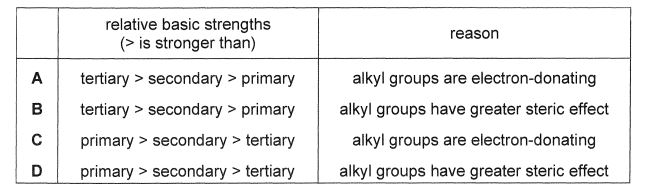
Which row correctly describes both the order of the gas phase relative basic strengths of primary, secondary and tertiary amines, and the possible reason for this order?
Video Solution
Explanation
The answer is A (tertiary > secondary > primary; alkyl groups are electron-donating).
Basic strength depends on how available the lone pair on N is for donation to \(\text{H}^+\).
In the gas phase there are no solvent molecules, so there is no solvation (hydrogen bonding with water) to stabilise the protonated ion. The order is controlled only by the electron-donating (positive inductive) effect of the alkyl groups.
Each alkyl group donates electron density to N, making the lone pair more available and also dispersing the positive charge on \(\text{R}_3\text{NH}^+\), so the more alkyl groups on N, the stronger the base:
tertiary (3 R groups) > secondary (2 R groups) > primary (1 R group).
• B is wrong: the order is correct, but a greater steric effect of the alkyl groups would hinder the approach of \(\text{H}^+\) to the lone pair and make the amine a weaker base, so it cannot explain why the tertiary amine is the strongest.
• C is wrong: the reason is correct, but electron-donating alkyl groups make the amine with the most alkyl groups the strongest base, so the order must be tertiary > secondary > primary, not the reverse.
• D is wrong: the order is reversed. \(\text{H}^+\) is very small, so steric effects do not control gas-phase basicity; the electron-donating effect of the alkyl groups does.
Want Mr Khemistry to teach you this?
Join a live JC H2 Chemistry class at Bukit Timah, Tampines, or online. Come for a trial lesson, no obligation.
Book a trial classPractice this topic
20+ more Nitrogen Compound questions with shuffled options in ChemBank, free for everyone. Want more? The ChemBank Premium ($100/month) unlocks 4,000+ TYS and Prelim questions, Paper 2 & 3 practice with worked solutions, and all simulations.
Open ChemBank free