2021 H2 Chem P1 Q2 — Atomic structure Solution
Question
An element Q forms an ionic nitrate with formula \(\text{QNO}_3\).
In a sample of this compound, the ion Q contains 80 electrons and 122 neutrons.
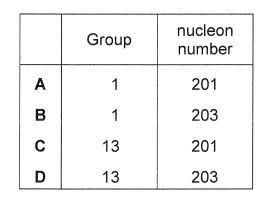
Which row describes:
• the Group where Q is found,
• the nucleon number of Q in this sample?
Video Solution
Explanation
The answer is D (Group 13, nucleon number 203).
\(\text{QNO}_3\) contains the nitrate ion \(\text{NO}_3^-\), so Q is present as the \(\text{Q}^+\) ion.
\(\text{Q}^+\) has 80 electrons, so the Q atom has 81 electrons and therefore 81 protons.
The element with proton number 81 is thallium, Tl, which is in Group 13 (Period 6, below In).
Nucleon number = protons + neutrons = 81 + 122 = 203.
Tl forms a 1+ ion because its 6s pair of electrons is reluctant to be removed (inert pair effect), so a 1+ ion does not make it a Group 1 element.
• A is wrong: Q is in Group 13, not Group 1, and its nucleon number is 203, not 201.
• B is wrong: the nucleon number 203 is right, but an element with 81 protons is in Group 13, not Group 1.
• C is wrong: the Group is right, but the nucleon number is 81 + 122 = 203, not 201.
Want Mr Khemistry to teach you this?
Join a live JC H2 Chemistry class at Bukit Timah, Tampines, or online. Come for a trial lesson, no obligation.
Book a trial classPractice this topic
20+ more Atomic structure questions with shuffled options in ChemBank, free for everyone. Want more? The ChemBank Premium ($100/month) unlocks 4,000+ TYS and Prelim questions, Paper 2 & 3 practice with worked solutions, and all simulations.
Open ChemBank free