2021 H2 Chem P1 Q17 — Arene Solution
Question
A reaction is carried out using an excess of methylbenzene in the absence of sunlight and in the presence of an iron-containing catalyst.
What is the main reaction taking place?
Video Solution
Explanation
The answer is C.
• In the absence of sunlight (no UV light) there is no free-radical substitution at the alkyl side-chain.
• Br is less electronegative than Cl, so BrCl is polarised as \(\text{Br}^{\delta+}\text{-Cl}^{\delta-}\). The iron-containing catalyst (as \(\text{FeX}_3\)) generates the electrophile \(\text{Br}^+\):
\(\text{BrCl} + \text{FeX}_3 \rightarrow \text{Br}^+ + [\text{FeX}_3\text{Cl}]^-\)
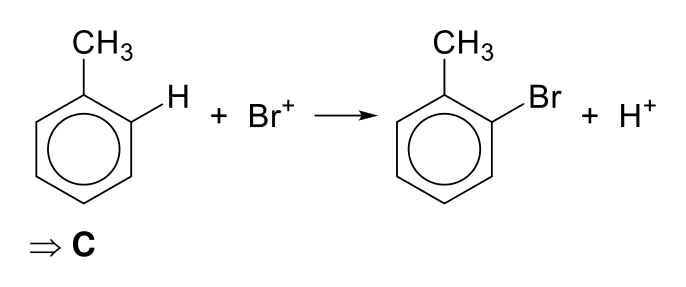
• \(\text{Br}^+\) substitutes a \(\text{H}^+\) on the benzene ring of methylbenzene by electrophilic substitution (the figure shows substitution at the 2-position, which the \(-\text{CH}_3\) group activates):
\(\text{C}_6\text{H}_5\text{CH}_3 + \text{Br}^+ \rightarrow \text{BrC}_6\text{H}_4\text{CH}_3 + \text{H}^+\)
• Methylbenzene is in excess, so only one bromine atom is substituted into the ring.
A ✗ and B ✗: Substitution into the \(-\text{CH}_3\) side-chain is free-radical substitution, which needs UV light (sunlight). The reaction is carried out in the absence of sunlight.
D ✗: Cl is the \(\delta-\) end of BrCl and ends up in \([\text{FeX}_3\text{Cl}]^-\). The electrophile is \(\text{Br}^+\), so bromine, not chlorine, is substituted into the ring.
Want Mr Khemistry to teach you this?
Join a live JC H2 Chemistry class at Bukit Timah, Tampines, or online. Come for a trial lesson, no obligation.
Book a trial classPractice this topic
20+ more Arene questions with shuffled options in ChemBank, free for everyone. Want more? The ChemBank Premium ($100/month) unlocks 4,000+ TYS and Prelim questions, Paper 2 & 3 practice with worked solutions, and all simulations.
Open ChemBank free