2021 H2 Chem P1 Q14 — Introduction to Organic Solution
Question
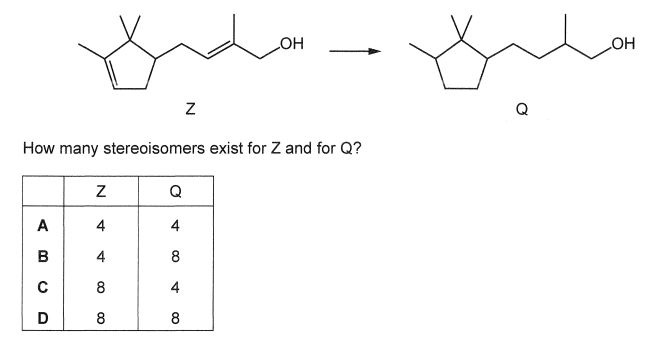
Video Solution
Explanation
The answer is B (Z has 4 stereoisomers, Q has 8).
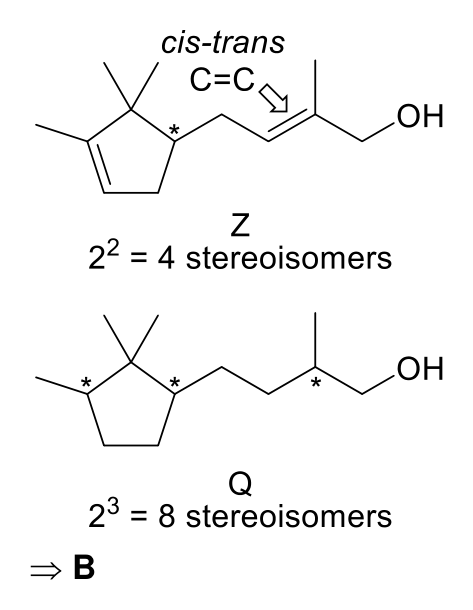
Z: two sources of stereoisomerism.
• One chiral carbon: the ring carbon bearing the side-chain is bonded to H, the side-chain \(\text{CH}_2\), the \(\text{C(CH}_3)_2\) ring carbon and the ring \(\text{CH}_2\), four different groups.
• The side-chain C=C shows cis-trans isomerism: one carbon carries H and \(\text{CH}_2\)(ring), the other carries \(\text{CH}_3\) and \(\text{CH}_2\text{OH}\).
• The ring C=C cannot show cis-trans isomerism because it is locked inside the five-membered ring.
Number of stereoisomers of Z = \(2^2 = 4\).
Q: hydrogenation removes both C=C bonds, so there is no cis-trans isomerism, but it creates new chiral carbons. Q has three chiral carbons:
• the ring carbon bearing the \(\text{CH}_3\) group (formerly part of the ring C=C),
• the ring carbon bearing the side-chain,
• the side-chain carbon bearing the \(\text{CH}_3\) group (bonded to H, \(\text{CH}_3\), \(\text{CH}_2\text{OH}\) and \(\text{CH}_2\text{CH}_2\)-ring).
The molecule has no internal plane of symmetry, so there are no meso forms. Number of stereoisomers of Q = \(2^3 = 8\).
• A is wrong: Z has 4 stereoisomers, but Q has 3 chiral carbons and so has 8 stereoisomers, not 4.
• C is wrong: the numbers are swapped. Z has only 2 stereogenic features (4 stereoisomers) because its ring C=C cannot show cis-trans isomerism, and Q has 3 chiral carbons (8 stereoisomers).
• D is wrong: Q has 8 stereoisomers, but Z has only 4, since the ring C=C does not give cis-trans isomers.
Want Mr Khemistry to teach you this?
Join a live JC H2 Chemistry class at Bukit Timah, Tampines, or online. Come for a trial lesson, no obligation.
Book a trial classPractice this topic
20+ more Introduction to Organic questions with shuffled options in ChemBank, free for everyone. Want more? The ChemBank Premium ($100/month) unlocks 4,000+ TYS and Prelim questions, Paper 2 & 3 practice with worked solutions, and all simulations.
Open ChemBank free