2021 H2 Chem P1 Q12 — Chemical equilibrium Solution
Question
\(\text{CaO(s)} + \text{CO}_2\text{(g)} \rightleftharpoons \text{CaCO}_3\text{(s)}\) \(\Delta H^\circ = -178\) kJ mol\(^{-1}\)
The vessel is attached to a plunger which can alter the pressure inside the vessel. At a time \(t\), the plunger is pulled out quickly to lower the pressure and then is released to allow the pressure to slowly return to atmospheric pressure. The constant temperature is maintained.
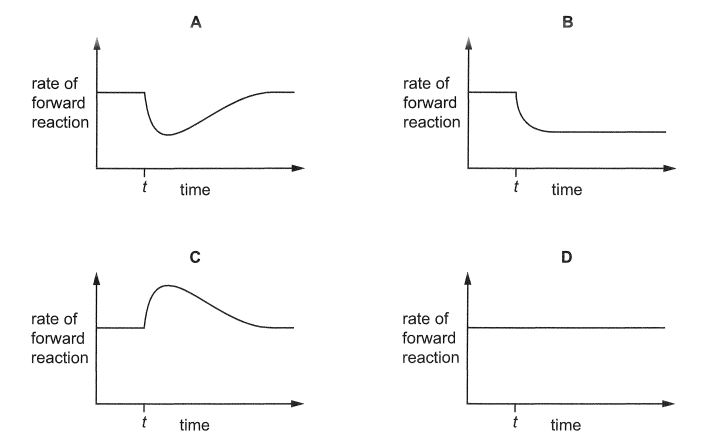
Which graph shows the change in the rate of the forward reaction during this pressure change?
Video Solution
Explanation
The answer is A.
CaO and \(\text{CaCO}_3\) are solids, so the rate of the forward reaction depends only on the partial pressure of \(\text{CO}_2\): rate of forward reaction \(\propto p_{\text{CO}_2}\).
• At time \(t\) the plunger is pulled out quickly, so the pressure, and hence \(p_{\text{CO}_2}\), falls suddenly. The rate of the forward reaction drops sharply.
• The position of equilibrium shifts left, and \(\text{CaCO}_3\) decomposes to produce more \(\text{CO}_2\) to counter this decrease, so \(p_{\text{CO}_2}\) rises again and the forward rate increases.
• The pressure is allowed to return slowly to atmospheric pressure at the same temperature. \(K_p = \frac{1}{p_{\text{CO}_2}}\) is unchanged, so \(p_{\text{CO}_2}\) returns to its original value and the forward rate slowly returns to its original value.
Graph A shows exactly this: a sharp fall at \(t\) followed by a gradual rise back to the original rate.
• B is wrong: it shows the rate falling at \(t\) and staying at the lower value. The pressure returns to atmospheric and \(p_{\text{CO}_2}\) returns to its equilibrium value, so the rate recovers to its original value.
• C is wrong: it shows the rate rising at \(t\). Lowering the pressure lowers \(p_{\text{CO}_2}\), so the forward rate falls, it does not rise.
• D is wrong: it shows no change at all, but the sudden fall in \(p_{\text{CO}_2}\) lowers the forward rate at time \(t\).
Want Mr Khemistry to teach you this?
Join a live JC H2 Chemistry class at Bukit Timah, Tampines, or online. Come for a trial lesson, no obligation.
Book a trial classPractice this topic
20+ more Chemical equilibrium questions with shuffled options in ChemBank, free for everyone. Want more? The ChemBank Premium ($100/month) unlocks 4,000+ TYS and Prelim questions, Paper 2 & 3 practice with worked solutions, and all simulations.
Open ChemBank free