2021 H2 Chem P1 Q1 — Atomic structure Solution
Question
Which statements are correct?
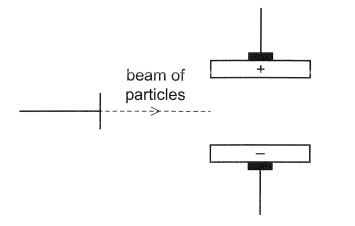
1) The electrons are deflected to a larger extent than the protons.
2) The electron beam is deflected in the opposite direction to the proton beam.
3) The proton beam travels in a straight path towards the negatively charged plate.
Video Solution
Explanation
The answer is B (1 and 2 only).
Statement 1 is true. The angle of deflection is proportional to \(\frac{\text{charge}}{\text{mass}}\). An electron and a proton carry charges of the same size, but the mass of an electron is about \(\frac{1}{1840}\) of the mass of a proton, so \(\frac{|z|}{m}\) is far larger for the electron and the electron beam is deflected much more.
Statement 2 is true. The electron is negatively charged, so it is attracted towards the positive plate; the proton is positively charged, so it is attracted towards the negative plate. The two beams bend in opposite directions.
Statement 3 is false. The proton beam does move towards the negatively charged plate, but not in a straight line. The attractive force acts on the protons continuously while they move forward, so they accelerate sideways and follow a curved path.
• A is wrong: it includes statement 3, which is false.
• C is wrong: it leaves out statement 1, which is true, and includes statement 3, which is false.
• D is wrong: statement 3 is the only false statement, and it leaves out the true statements 1 and 2.
Want Mr Khemistry to teach you this?
Join a live JC H2 Chemistry class at Bukit Timah, Tampines, or online. Come for a trial lesson, no obligation.
Book a trial classPractice this topic
20+ more Atomic structure questions with shuffled options in ChemBank, free for everyone. Want more? The ChemBank Premium ($100/month) unlocks 4,000+ TYS and Prelim questions, Paper 2 & 3 practice with worked solutions, and all simulations.
Open ChemBank free