2020 H2 Chem P1 Q6 — Gases Solution
Question
The volumes and pressures of equal masses of four gases, \(\text{N}_2\), \(\text{CH}_4\), \(Cl_2\) and Ne, are separately investigated, at constant temperature.
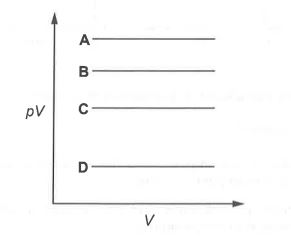
The results are plotted on a graph of \(pV\) against \(V\). All four gases behave as ideal gases under the conditions chosen.
Which plot shows the results for neon?
Video Solution
Explanation
The answer is B.
For an ideal gas, \(pV = nRT = \frac{m}{M_\text{r}}RT\).
The masses are equal and the temperature is constant, so for each gas \(pV\) is a constant (a horizontal line, whatever the value of \(V\)) and \(pV \propto \frac{1}{M_\text{r}}\): the smaller the \(M_\text{r}\), the higher the line.
\(M_\text{r}\): \(\text{CH}_4\) = 16.0, Ne = 20.2, \(\text{N}_2\) = 28.0, \(\text{Cl}_2\) = 71.0
Order of \(pV\), highest to lowest: \(\text{CH}_4\) \(>\) Ne \(>\) \(\text{N}_2\) \(>\) \(\text{Cl}_2\), which are lines A, B, C and D. Neon has the second smallest \(M_\text{r}\), so it is line B.
• A is wrong: the highest line belongs to the gas with the smallest \(M_\text{r}\), \(\text{CH}_4\) (16.0).
• C is wrong: the third line belongs to \(\text{N}_2\) (28.0), whose \(M_\text{r}\) is larger than that of Ne.
• D is wrong: the lowest line belongs to the gas with the largest \(M_\text{r}\), \(\text{Cl}_2\) (71.0).
Want Mr Khemistry to teach you this?
Join a live JC H2 Chemistry class at Bukit Timah, Tampines, or online. Come for a trial lesson, no obligation.
Book a trial classPractice this topic
20+ more Gases questions with shuffled options in ChemBank, free for everyone. Want more? The ChemBank Premium ($100/month) unlocks 4,000+ TYS and Prelim questions, Paper 2 & 3 practice with worked solutions, and all simulations.
Open ChemBank free