2020 H2 Chem P1 Q5 — Chemical bonding Solution
Question
The boiling point of trichloromethane is 61 °C. The boiling point of propanone is 56 °C.
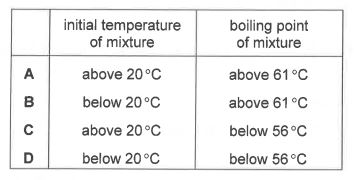
Which row is correct?
Video Solution
Explanation
The answer is A (above 20 °C; above 61 °C).
Temperature on mixing: the original intermolecular forces are broken (energy absorbed) and stronger intermolecular forces between \(\text{CHCl}_3\) and \(\text{CH}_3\text{COCH}_3\) are formed (more energy released). The H atom of \(\text{CHCl}_3\), made electron-poor by the three electronegative Cl atoms, is strongly attracted to the \(\delta-\) O atom of propanone. Overall, mixing releases energy, so the mixture warms up to above 20 °C.
Boiling point: to boil the mixture, these stronger attractions between \(\text{CHCl}_3\) and \(\text{CH}_3\text{COCH}_3\) must be overcome. This needs more energy than overcoming the forces in either pure liquid, so the mixture boils above the higher of the two boiling points, that is above 61 °C.
• B is wrong: a fall to below 20 °C would mean mixing is endothermic, that is the forces formed are weaker than those broken, which is the opposite of what the question states.
• C is wrong: the temperature rise is correct, but a boiling point below 56 °C would mean the forces in the mixture are weaker than those in pure propanone, when they are stronger.
• D is wrong: both entries are wrong, for the reasons given in B and C.
Want Mr Khemistry to teach you this?
Join a live JC H2 Chemistry class at Bukit Timah, Tampines, or online. Come for a trial lesson, no obligation.
Book a trial classPractice this topic
20+ more Chemical bonding questions with shuffled options in ChemBank, free for everyone. Want more? The ChemBank Premium ($100/month) unlocks 4,000+ TYS and Prelim questions, Paper 2 & 3 practice with worked solutions, and all simulations.
Open ChemBank free