2020 H2 Chem P1 Q4 — Chemical bonding Solution
Question
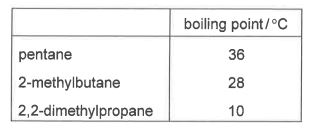
What is responsible for the differences in boiling points?
Video Solution
Explanation
The answer is D (stronger induced dipole attractions between straight chain molecules).
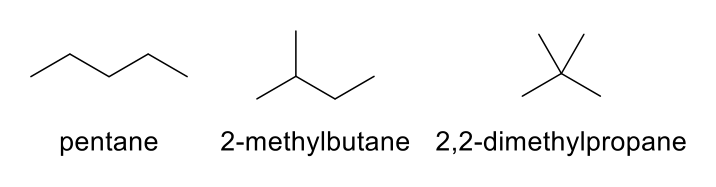
Pentane, 2-methylbutane and 2,2-dimethylpropane are constitutional isomers of \(\text{C}_5\text{H}_{12}\) with increasing branching. They are non-polar, so the only forces between their molecules are instantaneous dipole-induced dipole (id-id) attractions.
• The straight-chain pentane molecules are elongated and have the largest surface area of contact with neighbouring molecules, so their id-id attractions are the strongest and the boiling point is the highest (36 °C).
• With more branching, the molecule becomes more compact and spherical, the surface area of contact decreases, the id-id attractions become weaker and the boiling point falls (28 °C, then 10 °C).
• A is wrong: all three isomers have five carbon atoms and 4 C-C bonds each, so the number of C-C bonds is the same. Boiling also does not break any covalent bonds.
• B is wrong: the three compounds are isomers with the same molecular formula, so they all have the same \(M_\text{r}\) of 72.0.
• C is wrong: alkanes have no H atom bonded to N, O or F, so there is no hydrogen bonding between any of these molecules.
Want Mr Khemistry to teach you this?
Join a live JC H2 Chemistry class at Bukit Timah, Tampines, or online. Come for a trial lesson, no obligation.
Book a trial classPractice this topic
20+ more Chemical bonding questions with shuffled options in ChemBank, free for everyone. Want more? The ChemBank Premium ($100/month) unlocks 4,000+ TYS and Prelim questions, Paper 2 & 3 practice with worked solutions, and all simulations.
Open ChemBank free