2020 H2 Chem P1 Q30 — Transition elements Solution
Question
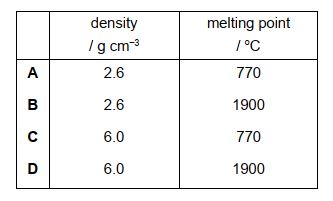
The table shows some physical properties of metals.
One row of the table shows two properties of strontium. Another row shows two properties of vanadium. The other two rows of the table each show one property of strontium and one property of vanadium.
Which row shows two properties of vanadium?
Video Solution
Explanation
The answer is D (density 6.0 \(\text{g cm}^{-3}\); melting point 1900 °C).
Vanadium is a transition element and strontium is a Group 2 metal.
• Melting point: in vanadium (\([\text{Ar}]3d^3 4s^2\)) both the 3d and 4s electrons are available for delocalisation and the atoms are small, so its metallic bonding is much stronger than in strontium, which has only two delocalised 5s electrons per atom and much larger atoms. So vanadium has the high melting point, 1900 °C, and strontium the lower one, 770 °C.
• Density: vanadium atoms are much smaller than strontium atoms and pack far more closely, so even though vanadium has the lower \(A_\text{r}\) (50.9 against 87.6), it has much more mass per unit volume. So vanadium has the density 6.0 \(\text{g cm}^{-3}\) and strontium 2.6 \(\text{g cm}^{-3}\).
Row D (6.0 and 1900) shows both properties of vanadium.
• A is wrong: 2.6 \(\text{g cm}^{-3}\) and 770 °C are the low density and low melting point, which are both properties of strontium.
• B is wrong: it pairs the density of strontium (2.6 \(\text{g cm}^{-3}\)) with the melting point of vanadium (1900 °C).
• C is wrong: it pairs the density of vanadium (6.0 \(\text{g cm}^{-3}\)) with the melting point of strontium (770 °C).
Want Mr Khemistry to teach you this?
Join a live JC H2 Chemistry class at Bukit Timah, Tampines, or online. Come for a trial lesson, no obligation.
Book a trial classPractice this topic
20+ more Transition elements questions with shuffled options in ChemBank, free for everyone. Want more? The ChemBank Premium ($100/month) unlocks 4,000+ TYS and Prelim questions, Paper 2 & 3 practice with worked solutions, and all simulations.
Open ChemBank free