2020 H2 Chem P1 Q29 — Transition elements Solution
Question
Video Solution
Explanation
The answer is A.
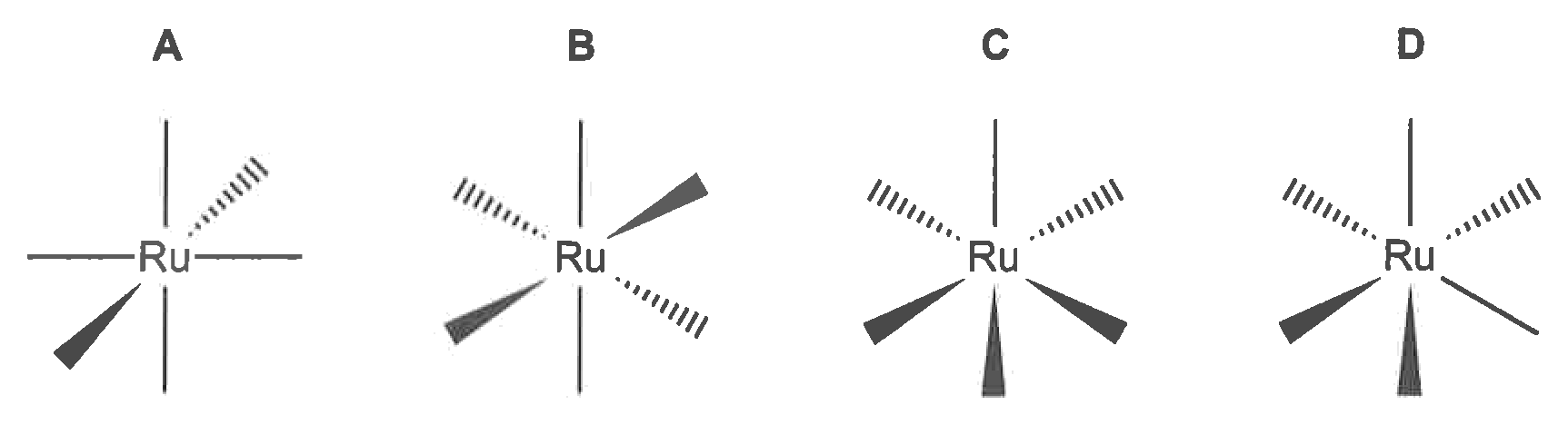
A regular octahedron has six bonds along three mutually perpendicular axes, all bond angles 90\(^\circ\), with each pair of opposite bonds at 180\(^\circ\). A plain line is a bond in the plane of the paper, a wedge points towards you and a dash points away from you. Two bonds at 180\(^\circ\) to each other must be drawn in exactly opposite directions from Ru, and if one of them points towards you the other must point away from you.
Diagram A is the octahedron viewed looking down one of its axes:
• the bonds going up, down, left and right are plain lines: four bonds in the plane of the paper at 90\(^\circ\) to each other (two axes);
• the wedge (lower left) and the dash (upper right) are directly opposite each other: one bond towards you and one away from you, along the third axis, perpendicular to the paper.
• B is wrong: the up and down bonds are plain, but the other four are drawn as wedge opposite wedge (upper right and lower left) and dash opposite dash (upper left and lower right). Two bonds that both point towards you, or both point away from you, cannot be at 180\(^\circ\) to each other, so these bonds do not form straight pairs through Ru.
• C is wrong: only the upward bond is plain (in the plane of the paper). The bond directly opposite it, going down, is a wedge, so it points towards you and cannot be at 180\(^\circ\) to a bond in the plane of the paper. The six bonds (one plain, three wedges, two dashes) cannot be split into three pairs of opposite bonds along three perpendicular axes.
• D is wrong: the only plain bonds are the one going up and the one going to the lower right, which are neither at 90\(^\circ\) nor at 180\(^\circ\) to each other, and the bond opposite the upward bond is a wedge. The six bonds are not drawn along three perpendicular axes.
Want Mr Khemistry to teach you this?
Join a live JC H2 Chemistry class at Bukit Timah, Tampines, or online. Come for a trial lesson, no obligation.
Book a trial classPractice this topic
20+ more Transition elements questions with shuffled options in ChemBank, free for everyone. Want more? The ChemBank Premium ($100/month) unlocks 4,000+ TYS and Prelim questions, Paper 2 & 3 practice with worked solutions, and all simulations.
Open ChemBank free