2020 H2 Chem P1 Q24 — Nitrogen Compound Solution
Question
\(\text{C}_2\text{H}_5\text{NH}_2 + \text{HCl} \rightleftharpoons \text{C}_2\text{H}_5\text{NH}_3^+\text{Cl}^-\) equilibrium 1
\((\text{C}_2\text{H}_5)_2\text{NH} + \text{HCl} \rightleftharpoons (\text{C}_2\text{H}_5)_2\text{NH}_2^+\text{Cl}^-\) equilibrium 2
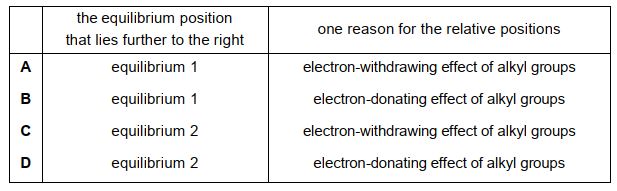
Which row correctly identifies:
- which equilibrium position lies further to the right,
- one reason for the relative positions of the two equilibria?
Video Solution
Explanation
The answer is D (equilibrium 2; electron-donating effect of alkyl groups).
Both amines act as Lewis bases by donating the lone pair on N to the H of HCl. Alkyl groups are electron-donating. Diethylamine has two ethyl groups on N, while ethylamine has only one, so in diethylamine:
• the electron density on N is higher, and its lone pair is more available for donation to H of HCl;
• the positive charge on the product ion, \((\text{C}_2\text{H}_5)_2\text{NH}_2^+\), is dispersed more, so this ion is more stable.
In the gas phase there are no solvent effects, so diethylamine is the stronger Lewis base and equilibrium 2 lies further to the right.
• A is wrong: alkyl groups are not electron-withdrawing, and equilibrium 1 does not lie further to the right.
• B is wrong: the electron-donating effect is the correct reason, but it makes the amine with more alkyl groups (diethylamine) the stronger base, so it is equilibrium 2, not equilibrium 1, that lies further to the right.
• C is wrong: equilibrium 2 is correct, but the reason is not: alkyl groups are electron-donating, and electron-withdrawing groups would make the lone pair less available, making the amine with more of them the weaker base.
Want Mr Khemistry to teach you this?
Join a live JC H2 Chemistry class at Bukit Timah, Tampines, or online. Come for a trial lesson, no obligation.
Book a trial classPractice this topic
20+ more Nitrogen Compound questions with shuffled options in ChemBank, free for everyone. Want more? The ChemBank Premium ($100/month) unlocks 4,000+ TYS and Prelim questions, Paper 2 & 3 practice with worked solutions, and all simulations.
Open ChemBank free