2020 H2 Chem P1 Q22 — Carbonyl Compound Solution
Question
V reacts with Tollens' reagent.
W reacts with alkaline aqueous iodine solution.
What could be the structure of V?
Video Solution
Explanation
The answer is B (1 and 2 only).
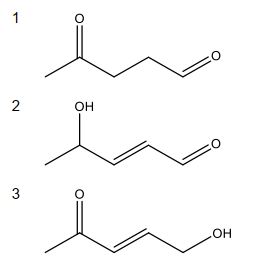
• V, \(\text{C}_5\text{H}_8\text{O}_2\), has \(\frac{2(5)+2-8}{2} = 2\) degrees of unsaturation, while W, \(\text{C}_5\text{H}_{12}\text{O}_2\), has none. V gains 4 H on reduction, so two C=C and/or C=O bonds in V are reduced. Structures 1, 2 and 3 all have the formula \(\text{C}_5\text{H}_8\text{O}_2\) with two such bonds.
• V gives a silver mirror with Tollens' reagent, so V is an aldehyde (contains -CHO). Structures 1 and 2 have -CHO; structure 3 has none.
• W gives a yellow precipitate (\(\text{CHI}_3\)) with alkaline aqueous iodine, so W contains the \(\text{CH}_3\text{CH(OH)}\)- group.
Structure 1 contains \(\text{CH}_3\text{CO}\)-, which is reduced to \(\text{CH}_3\text{CH(OH)}\)-. Structure 2 already contains \(\text{CH}_3\text{CH(OH)}\)-. Both reduce fully to W = \(\text{CH}_3\text{CH(OH)CH}_2\text{CH}_2\text{CH}_2\text{OH}\), which gives a positive iodoform test.
• A and C include structure 3, which has no -CHO group and so does not react with Tollens' reagent (it would still give a W that reacts with alkaline iodine).
• D leaves out structure 2, which has -CHO and whose reduced product W contains \(\text{CH}_3\text{CH(OH)}\)-.
Want Mr Khemistry to teach you this?
Join a live JC H2 Chemistry class at Bukit Timah, Tampines, or online. Come for a trial lesson, no obligation.
Book a trial classPractice this topic
20+ more Carbonyl Compound questions with shuffled options in ChemBank, free for everyone. Want more? The ChemBank Premium ($100/month) unlocks 4,000+ TYS and Prelim questions, Paper 2 & 3 practice with worked solutions, and all simulations.
Open ChemBank free