2020 H2 Chem P1 Q16 — Kinetics Solution
Question
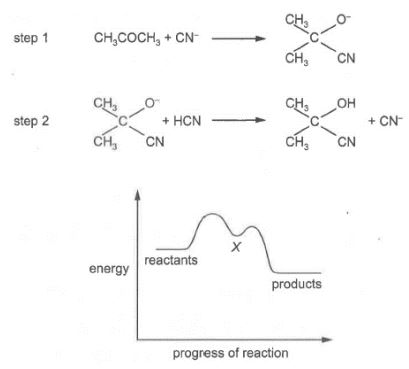
Which conclusion can be drawn from the reaction pathway diagram?
Video Solution
Explanation
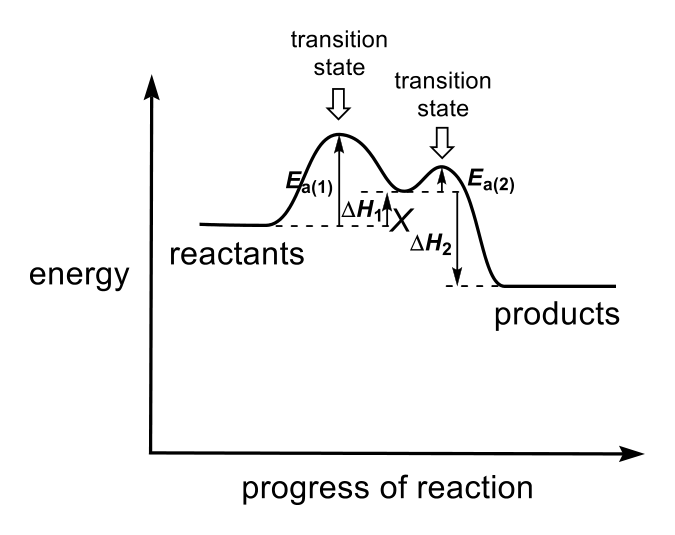
The answer is B (the activation energy for step 1 is greater than that for step 2).
Activation energy is the energy difference between the reactant(s) of a step and the transition state of that step. In the diagram, the first peak (from reactants to the 1st transition state) is much higher than the second peak (from intermediate X to the 2nd transition state), so \(E_{a(1)} > E_{a(2)}\).
• A: point X is a local energy minimum between the two peaks, so it is an intermediate (the alkoxide ion formed in step 1). Transition states are the local energy maxima.
• C: bond formation always releases energy, so forming the C-C bond is exothermic. Step 1 as a whole is endothermic (\(\Delta H_1 > 0\)) because it also breaks the C=O \(\pi\) bond.
• D: a reaction pathway diagram can be read from left to right or from right to left, since the reverse reaction always has a finite activation energy. So the diagram can never show that a reaction is not reversible.
Want Mr Khemistry to teach you this?
Join a live JC H2 Chemistry class at Bukit Timah, Tampines, or online. Come for a trial lesson, no obligation.
Book a trial classPractice this topic
20+ more Kinetics questions with shuffled options in ChemBank, free for everyone. Want more? The ChemBank Premium ($100/month) unlocks 4,000+ TYS and Prelim questions, Paper 2 & 3 practice with worked solutions, and all simulations.
Open ChemBank free