2020 H2 Chem P1 Q15 — Acid base equilibrium Solution
Question
Video Solution
Explanation
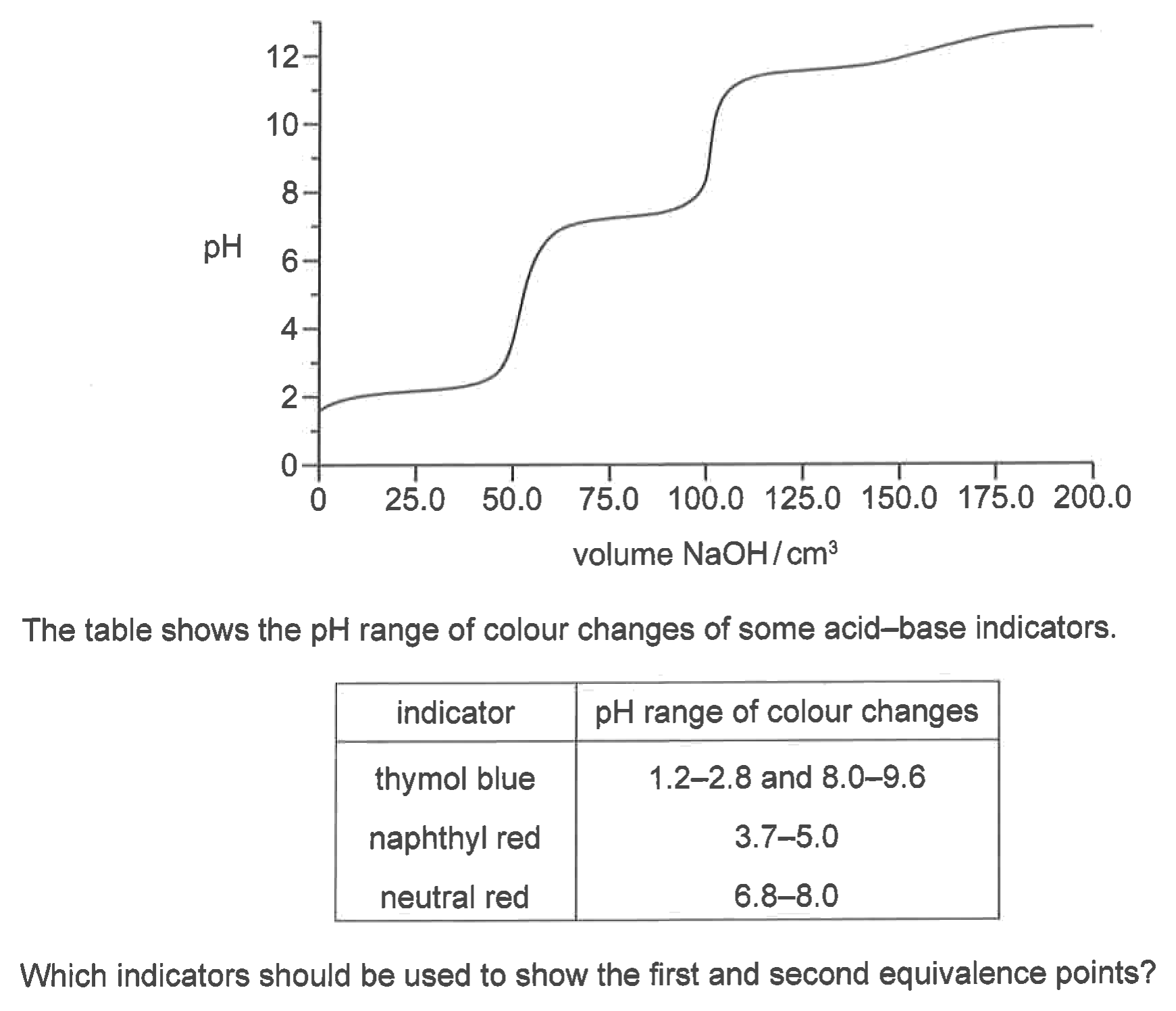
The answer is B (naphthyl red and then thymol blue).
An indicator is suitable only if its pH range of colour change lies within the steep (vertical) part of the curve at that equivalence point.
• First equivalence point (about 50 \(\text{cm}^3\) NaOH): the pH rises steeply from about 3 to about 6.5, with the equivalence point at about pH 5. Naphthyl red (3.7 to 5.0) changes colour within this steep rise.
• Second equivalence point (about 100 \(\text{cm}^3\) NaOH): the pH rises steeply from about 8 to about 11, with the equivalence point at about pH 9. The second range of thymol blue (8.0 to 9.6) lies within this steep rise.
• A: thymol blue's first range (1.2 to 2.8) lies in the flat region at the start of the titration, before the first steep rise, so it would change colour gradually well before the first equivalence point.
• C: thymol blue is unsuitable for the first equivalence point (as in A), and neutral red (6.8 to 8.0) changes colour in the flat buffer region at about pH 7 between the two steep rises, not at the second equivalence point.
• D: naphthyl red is correct for the first equivalence point, but neutral red (6.8 to 8.0) changes colour in the flat buffer region at about pH 7, not within the steep rise at the second equivalence point.
Want Mr Khemistry to teach you this?
Join a live JC H2 Chemistry class at Bukit Timah, Tampines, or online. Come for a trial lesson, no obligation.
Book a trial classPractice this topic
20+ more Acid base equilibrium questions with shuffled options in ChemBank, free for everyone. Want more? The ChemBank Premium ($100/month) unlocks 4,000+ TYS and Prelim questions, Paper 2 & 3 practice with worked solutions, and all simulations.
Open ChemBank free