2020 H2 Chem P1 Q14 — Chemical equilibrium Solution
Question
\(\text{P} + \text{Q} \rightleftharpoons \text{R} + 2\text{S}\)
Substances P, Q, R and S are either all in solution or are all gases.
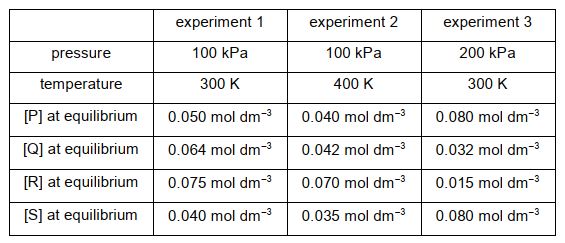
The equilibrium concentrations of P, Q, R and S are measured in three experiments. The experiments have different starting concentrations and are performed under different conditions.
The results are shown in the table.
Which conclusion can be drawn from these results?
Video Solution
Explanation
The answer is C (the forward reaction is endothermic).
\(\text{P} + \text{Q} \rightleftharpoons \text{R} + 2\text{S}\) \(K_c = \frac{[\text{R}][\text{S}]^2}{[\text{P}][\text{Q}]}\)
\(K_c(1) = \frac{0.075 \times 0.040^2}{0.050 \times 0.064} = 0.0375\text{ mol dm}^{-3}\) (300 K, 100 kPa)
\(K_c(2) = \frac{0.070 \times 0.035^2}{0.040 \times 0.042} = 0.0510\text{ mol dm}^{-3}\) (400 K, 100 kPa)
\(K_c(3) = \frac{0.015 \times 0.080^2}{0.080 \times 0.032} = 0.0375\text{ mol dm}^{-3}\) (300 K, 200 kPa)
\(K_c\) increases when the temperature is raised from 300 K to 400 K. A rise in temperature favours the endothermic direction, so the forward reaction is endothermic.
• A and B: experiments 1 and 3 are at the same temperature and give the same \(K_c\). \(K_c\) depends only on temperature whether the species are gases or in solution, and the experiments start from different concentrations, so the data give no way of telling which state the substances are in.
• D: for an exothermic forward reaction, \(K_c\) would decrease as the temperature rises, but it increases from 0.0375 to 0.0510.
Want Mr Khemistry to teach you this?
Join a live JC H2 Chemistry class at Bukit Timah, Tampines, or online. Come for a trial lesson, no obligation.
Book a trial classPractice this topic
20+ more Chemical equilibrium questions with shuffled options in ChemBank, free for everyone. Want more? The ChemBank Premium ($100/month) unlocks 4,000+ TYS and Prelim questions, Paper 2 & 3 practice with worked solutions, and all simulations.
Open ChemBank free