2020 H2 Chem P1 Q12 — Kinetics Solution
Question
\(2\text{MnO}_4^- + 16\text{H}^+ + 5\text{C}_2\text{O}_4^{2-} \rightarrow 2\text{Mn}^{2+} + 8\text{H}_2\text{O} + 10\text{CO}_2\)
25.0 cm\(^3\) of 0.01 mol dm\(^{-3}\) potassium manganate(VII) was added to 25.0 cm\(^3\) of 0.01 mol dm\(^{-3}\) ethanedioic acid.
Video Solution
Explanation
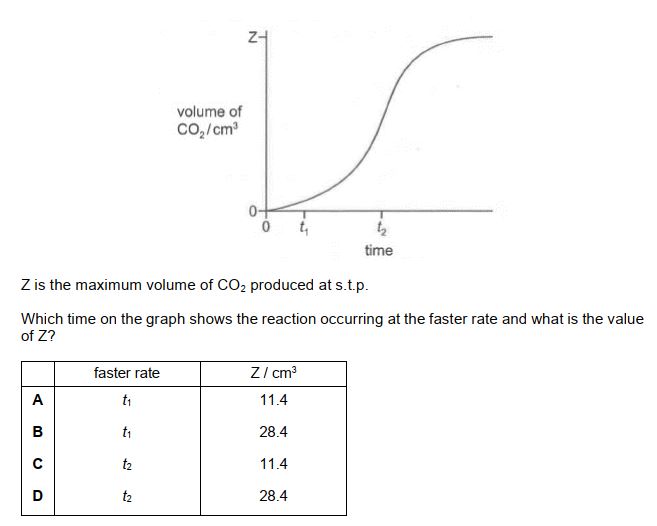
The answer is C (\(t_2\); 11.4 \(\text{cm}^3\)).
Faster rate: the rate at any time is the gradient of the volume-time graph. The curve is much steeper at \(t_2\) than at \(t_1\), so the reaction is faster at \(t_2\). (The reaction starts slowly and speeds up because the \(\text{Mn}^{2+}\) formed catalyses it.)
Value of Z:
\(n(\text{MnO}_4^-) = n(\text{C}_2\text{O}_4^{2-}) = \frac{25.0}{1000} \times 0.01 = 2.50 \times 10^{-4}\) mol
\(\text{MnO}_4^-\) needed to react with all the \(\text{C}_2\text{O}_4^{2-}\) \(= \frac{2}{5} \times 2.50 \times 10^{-4} = 1.00 \times 10^{-4}\) mol, which is less than the \(2.50 \times 10^{-4}\) mol available. So \(\text{MnO}_4^-\) is in excess and \(\text{C}_2\text{O}_4^{2-}\) is the limiting reagent.
\(n(\text{CO}_2) = \frac{10}{5} \times 2.50 \times 10^{-4} = 5.00 \times 10^{-4}\) mol
Z \(= 5.00 \times 10^{-4} \times 22.7 = 0.01135\ \text{dm}^3 = 11.4\ \text{cm}^3\) (molar volume at s.t.p. = 22.7 \(\text{dm}^3\ \text{mol}^{-1}\))
• A is wrong: Z = 11.4 \(\text{cm}^3\) is correct, but \(t_1\) is on the flatter early part of the curve, where the reaction is slower.
• B is wrong: \(t_1\) is the slower time, and 28.4 \(\text{cm}^3\) comes from treating \(\text{MnO}_4^-\) as the limiting reagent: \(\frac{10}{2} \times 2.50 \times 10^{-4} = 1.25 \times 10^{-3}\) mol \(\text{CO}_2\), and \(1.25 \times 10^{-3} \times 22.7 = 0.0284\ \text{dm}^3\). But \(\text{MnO}_4^-\) is in excess.
• D is wrong: \(t_2\) is correct, but Z = 28.4 \(\text{cm}^3\) has the same error as B.
Want Mr Khemistry to teach you this?
Join a live JC H2 Chemistry class at Bukit Timah, Tampines, or online. Come for a trial lesson, no obligation.
Book a trial classPractice this topic
20+ more Kinetics questions with shuffled options in ChemBank, free for everyone. Want more? The ChemBank Premium ($100/month) unlocks 4,000+ TYS and Prelim questions, Paper 2 & 3 practice with worked solutions, and all simulations.
Open ChemBank free