2020 H2 Chem P1 Q10 — Kinetics Solution
Question
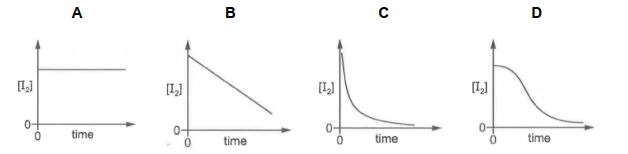
Which diagram represents the variation of \([\text{I}_2]\) with time?
Video Solution
Explanation
The answer is B.
The reaction is zero order with respect to iodine, so rate \(= -\frac{d[\text{I}_2]}{dt} = k[\text{I}_2]^0 = k\), a constant (taking the propanone and acid concentrations to stay effectively constant). The gradient of the \([\text{I}_2]\)-time graph is therefore constant, and since \(\text{I}_2\) is used up, \([\text{I}_2]\) decreases. The graph is a straight line sloping downwards, which is B.
• A is wrong: a horizontal line means \([\text{I}_2]\) does not change, so the rate would be zero and no reaction would occur.
• C is wrong: a curve that falls steeply and then levels off with a constant half-life shows a first-order reaction, where the rate is proportional to \([\text{I}_2]\) and falls as \([\text{I}_2]\) falls.
• D is wrong: the curve starts nearly flat, becomes steeper and then flattens again, so its gradient (the rate) changes throughout instead of staying constant.
Want Mr Khemistry to teach you this?
Join a live JC H2 Chemistry class at Bukit Timah, Tampines, or online. Come for a trial lesson, no obligation.
Book a trial classPractice this topic
20+ more Kinetics questions with shuffled options in ChemBank, free for everyone. Want more? The ChemBank Premium ($100/month) unlocks 4,000+ TYS and Prelim questions, Paper 2 & 3 practice with worked solutions, and all simulations.
Open ChemBank free