2019 H2 Chem P1 Q9 — Periodic table Solution
Question
From which two Period 3 elements could X be made?
Video Solution
Explanation
The answer is D (Mg and Si).
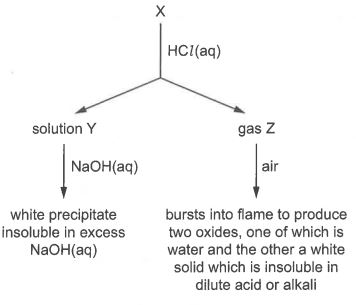
• Solution Y gives a white precipitate with NaOH(aq) that is insoluble in excess, so Y contains \(\text{Mg}^{2+}\) (precipitate \(\text{Mg(OH)}_2\)). \(\text{Al}^{3+}\) would give white \(\text{Al(OH)}_3\), which dissolves in excess NaOH(aq) because it is amphoteric.
• Gas Z burns in air to give water and a white solid that is insoluble in dilute acid or alkali. That solid is \(\text{SiO}_2\) (giant covalent; it reacts only with hot concentrated alkali), so Z is silane, \(\text{SiH}_4\).
Hence X is magnesium silicide, \(\text{Mg}_2\text{Si}\):
\(\text{Mg}_2\text{Si} + 4\text{HCl} \rightarrow 2\text{MgCl}_2 + \text{SiH}_4\)
\(\text{SiH}_4 + 2\text{O}_2 \rightarrow \text{SiO}_2 + 2\text{H}_2\text{O}\)
• A (Al and P): the \(\text{Al(OH)}_3\) precipitate dissolves in excess NaOH(aq), and the phosphorus gas (\(\text{PH}_3\)) would burn to \(\text{P}_4\text{O}_{10}\), an acidic oxide that reacts with alkali.
• B (Al and Si): the \(\text{Al(OH)}_3\) precipitate dissolves in excess NaOH(aq).
• C (Mg and P): solution Y fits, but the white solid would be \(\text{P}_4\text{O}_{10}\), an acidic oxide that reacts with alkali, so it is not insoluble in alkali.
Want Mr Khemistry to teach you this?
Join a live JC H2 Chemistry class at Bukit Timah, Tampines, or online. Come for a trial lesson, no obligation.
Book a trial classPractice this topic
20+ more Periodic table questions with shuffled options in ChemBank, free for everyone. Want more? The ChemBank Premium ($100/month) unlocks 4,000+ TYS and Prelim questions, Paper 2 & 3 practice with worked solutions, and all simulations.
Open ChemBank free