2019 H2 Chem P1 Q8 — Periodic table Solution
Question
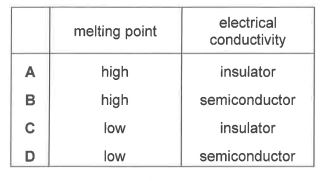
On this basis, which predictions can be made about the physical properties of element 32, germanium?
Video Solution
Explanation
The answer is B (high melting point, semiconductor).
Germanium (element 32) is in Group 14, directly below silicon in Period 3, so it should behave like silicon.
• Silicon has a giant covalent (giant molecular) lattice: every atom is joined to four others by strong covalent bonds, and a lot of energy is needed to break them, so it has a high melting point. Germanium has the same structure, so it also has a high melting point.
• Silicon is a metalloid and a semiconductor, conducting electricity slightly, and better as temperature rises. Germanium is predicted to be a semiconductor too.
• A is wrong: the high melting point is right, but silicon, the Period 3 element in the same group, is a semiconductor, not an insulator.
• C is wrong: a low melting point would mean a simple molecular structure held by weak id-id forces, as in \(\text{P}_4\) or \(\text{S}_8\), not the giant covalent structure of Group 14; and Ge is not an insulator.
• D is wrong: semiconductor is right, but a giant covalent lattice gives a high melting point, not a low one.
Want Mr Khemistry to teach you this?
Join a live JC H2 Chemistry class at Bukit Timah, Tampines, or online. Come for a trial lesson, no obligation.
Book a trial classPractice this topic
20+ more Periodic table questions with shuffled options in ChemBank, free for everyone. Want more? The ChemBank Premium ($100/month) unlocks 4,000+ TYS and Prelim questions, Paper 2 & 3 practice with worked solutions, and all simulations.
Open ChemBank free