2019 H2 Chem P1 Q4 — Chemical bonding Solution
Question
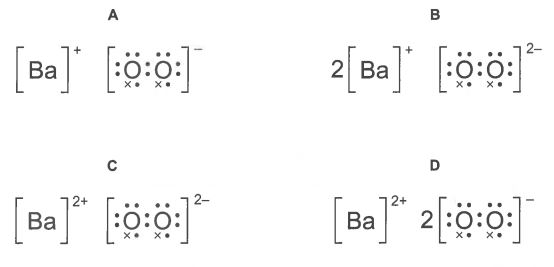
Which dot-and-cross diagram shows the bonding present in barium peroxide?
Video Solution
Explanation
The answer is C.
• Barium is in Group 2, so it loses both of its valence electrons to form \(\text{Ba}^{2+}\).
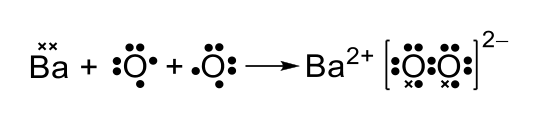
• In the peroxide ion the two O atoms share one pair of electrons (O-O single bond). Each O atom then has 7 electrons in its outer shell, so each gains one electron (×) from barium to complete its octet. With 2 gained electrons the ion is \(\text{O}_2^{2-}\).
• One \(\text{Ba}^{2+}\) balances one \(\text{O}_2^{2-}\), giving \(\text{BaO}_2\). Diagram C shows exactly this (see figure).
• A is wrong: Ba forms \(\text{Ba}^{2+}\), not \(\text{Ba}^+\), and the anion as drawn contains two × electrons gained from barium, so its charge must be 2-, not 1-.
• B is wrong: the anion is correct, but Ba loses both valence electrons to form \(\text{Ba}^{2+}\); two \(\text{Ba}^+\) ions would give the formula \(\text{Ba}_2\text{O}_2\), not barium peroxide, \(\text{BaO}_2\).
• D is wrong: \(\text{Ba}^{2+}\) is correct, but each anion as drawn has gained two × electrons, so it must carry a 2- charge, not 1-; and two anions per \(\text{Ba}^{2+}\) gives \(\text{Ba(O}_2\text{)}_2\), not \(\text{BaO}_2\).
Want Mr Khemistry to teach you this?
Join a live JC H2 Chemistry class at Bukit Timah, Tampines, or online. Come for a trial lesson, no obligation.
Book a trial classPractice this topic
20+ more Chemical bonding questions with shuffled options in ChemBank, free for everyone. Want more? The ChemBank Premium ($100/month) unlocks 4,000+ TYS and Prelim questions, Paper 2 & 3 practice with worked solutions, and all simulations.
Open ChemBank free