2019 H2 Chem P1 Q21 — Nitrogen Compound Solution
Question
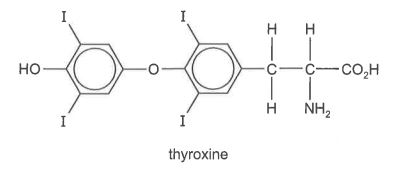
Which parts of the thyroxine molecule will react with NaOH(aq)?
Video Solution
Explanation
The answer is D.
NaOH(aq) is a base, so it reacts with the acidic groups of thyroxine in acid-base reactions:
• the \(-\text{CO}_2\text{H}\) group: \(\text{RCO}_2\text{H} + \text{NaOH} \rightarrow \text{RCO}_2^-\text{Na}^+ + \text{H}_2\text{O}\)
• the phenolic -OH group (bonded directly to the benzene ring): phenol is acidic enough to react with NaOH, giving the phenoxide \(\text{ArO}^-\text{Na}^+\) and water.
Groups that do not react:
• the four I atoms are bonded directly to benzene rings. A lone pair on I delocalises into the ring, giving the C-I bond partial double-bond character, so it is not hydrolysed by NaOH(aq).
• the ether link, C-O-C, is unreactive towards bases.
• the \(-\text{NH}_2\) group is basic, so it does not react with NaOH.
• A: leaves out the phenolic -OH group, which also reacts.
• B: the aryl I atoms do not react, and the phenolic -OH group is left out.
• C: leaves out the \(-\text{CO}_2\text{H}\) group, which also reacts.
Want Mr Khemistry to teach you this?
Join a live JC H2 Chemistry class at Bukit Timah, Tampines, or online. Come for a trial lesson, no obligation.
Book a trial classPractice this topic
20+ more Nitrogen Compound questions with shuffled options in ChemBank, free for everyone. Want more? The ChemBank Premium ($100/month) unlocks 4,000+ TYS and Prelim questions, Paper 2 & 3 practice with worked solutions, and all simulations.
Open ChemBank free