2019 H2 Chem P1 Q2 — Atomic structure Solution
Question
Video Solution
Explanation
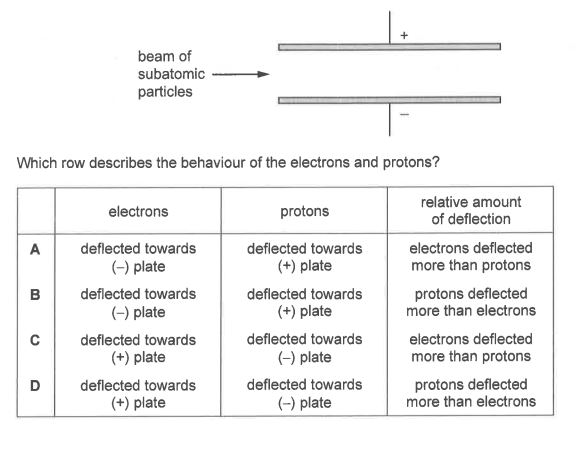
The answer is C (electrons towards the (+) plate, protons towards the (-) plate, electrons deflected more than protons).
• Direction: opposite charges attract. Electrons are negatively charged, so they bend towards the positive (+) plate. Protons are positively charged, so they bend towards the negative (-) plate.
• Amount: for particles entering at the same velocity, the angle of deflection is proportional to charge/mass. An electron and a proton carry the same size of charge (1 unit), but the electron's mass is only about \(\dfrac{1}{1840}\) of the proton's mass, so the electron has a much larger charge/mass ratio and is deflected much more.
• A is wrong: the relative amount is right, but both directions are reversed; a negative electron is repelled by the (-) plate, not attracted to it.
• B is wrong: both directions are reversed, and the proton, with the smaller charge/mass ratio, is deflected less, not more.
• D is wrong: the directions are right, but protons are about 1840 times heavier for the same size of charge, so they are deflected less than electrons.
Want Mr Khemistry to teach you this?
Join a live JC H2 Chemistry class at Bukit Timah, Tampines, or online. Come for a trial lesson, no obligation.
Book a trial classPractice this topic
20+ more Atomic structure questions with shuffled options in ChemBank, free for everyone. Want more? The ChemBank Premium ($100/month) unlocks 4,000+ TYS and Prelim questions, Paper 2 & 3 practice with worked solutions, and all simulations.
Open ChemBank free