2019 H2 Chem P1 Q19 — Arene Solution
Question
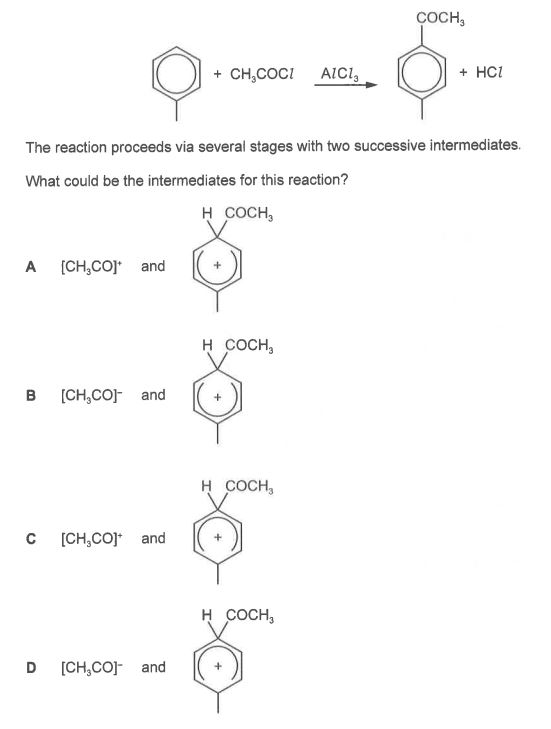
The reaction proceeds via several stages with two successive intermediates.
What could be the intermediates for this reaction?
Video Solution
Explanation
The answer is A.
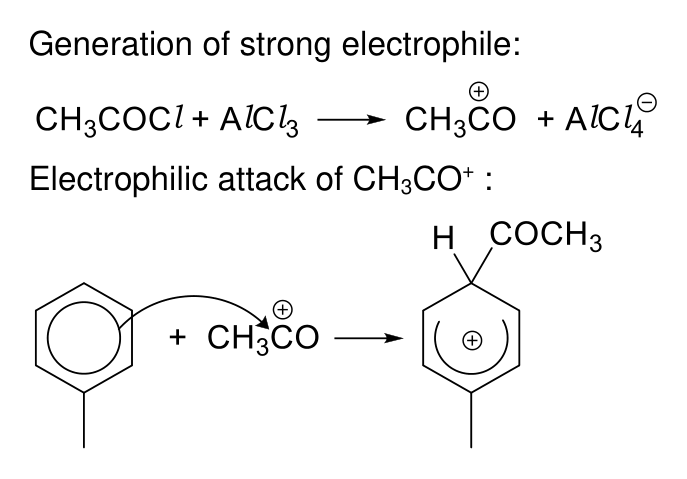
This is Friedel-Crafts acylation, an electrophilic substitution (see figure).
1. \(\text{AlCl}_3\) (a Lewis acid) removes Cl from ethanoyl chloride to form the electrophile, the acylium cation: \(\text{CH}_3\text{COCl} + \text{AlCl}_3 \rightarrow \text{CH}_3\text{CO}^+ + \text{AlCl}_4^-\). This is the first intermediate.
2. The \(\pi\) electrons of the ring attack \(\text{CH}_3\text{CO}^+\), forming the arenium cation. The ring carbon that gains the \(\text{COCH}_3\) group becomes sp\(^3\) (it carries H and \(\text{COCH}_3\)), so the positive charge is delocalised over the other five ring carbons. This is the second intermediate. Loss of \(\text{H}^+\) then restores the aromatic ring.
In option A the arc drawn inside the ring leaves its gap at the sp\(^3\) carbon bearing H and \(\text{COCH}_3\), showing delocalisation over the five sp\(^2\) carbons.
• B: \([\text{CH}_3\text{CO}]^-\) is an anion. An anion cannot act as the electrophile that attacks the electron-rich ring.
• C: correct acylium cation, but the arc leaves its gap at the carbon bearing \(\text{CH}_3\) and runs through the sp\(^3\) carbon, which has no p orbital to take part in the delocalisation.
• D: an anion as the first intermediate, and the arc leaves its gap at the wrong carbon, as in C.
Want Mr Khemistry to teach you this?
Join a live JC H2 Chemistry class at Bukit Timah, Tampines, or online. Come for a trial lesson, no obligation.
Book a trial classPractice this topic
20+ more Arene questions with shuffled options in ChemBank, free for everyone. Want more? The ChemBank Premium ($100/month) unlocks 4,000+ TYS and Prelim questions, Paper 2 & 3 practice with worked solutions, and all simulations.
Open ChemBank free