2019 H2 Chem P1 Q17 — Introduction to Organic Solution
Question
What is the lowest number of carbon atoms an ether molecule must contain to have a chiral carbon atom?
Video Solution
Explanation
The answer is B (5).
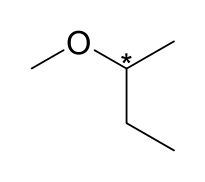
A chiral carbon must be bonded to four different groups. Ignoring cyclic ethers, the smallest way to do this in an ether is a carbon bonded to O, H, \(\text{CH}_3\) and \(\text{C}_2\text{H}_5\), i.e. a \(\text{CH(CH}_3\text{)CH}_2\text{CH}_3\) group (4 C) on the oxygen. The oxygen must also carry a second hydrocarbon group with at least 1 C, so the minimum is 5 C: 2-methoxybutane, \(\text{CH}_3\text{OCH(CH}_3\text{)CH}_2\text{CH}_3\) (chiral carbon marked in the figure).
If the chiral carbon is not bonded to O, it needs H, \(\text{CH}_3\), \(\text{C}_2\text{H}_5\) and a group containing the ether link such as \(\text{CH}_2\text{OCH}_3\), which takes 6 C.
• A (4): the only ethers with 4 C are \(\text{CH}_3\text{OCH}_2\text{CH}_2\text{CH}_3\), \(\text{CH}_3\text{OCH(CH}_3\text{)}_2\) and \(\text{CH}_3\text{CH}_2\text{OCH}_2\text{CH}_3\); none has a carbon bonded to four different groups.
• C (6) and D (7): chiral ethers with 6 or 7 C exist, but 5 C is already enough, so these are not the lowest number.
Want Mr Khemistry to teach you this?
Join a live JC H2 Chemistry class at Bukit Timah, Tampines, or online. Come for a trial lesson, no obligation.
Book a trial classPractice this topic
20+ more Introduction to Organic questions with shuffled options in ChemBank, free for everyone. Want more? The ChemBank Premium ($100/month) unlocks 4,000+ TYS and Prelim questions, Paper 2 & 3 practice with worked solutions, and all simulations.
Open ChemBank free