2019 H2 Chem P1 Q12 — Thermochemistry Solution
Question
Which description of one of the enthalpy changes is correct?
Video Solution
Explanation
The answer is B.
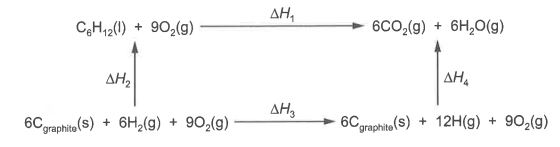
• A: incorrect. \(\Delta H_1\) forms \(\text{H}_2\text{O(g)}\). The standard enthalpy change of combustion (298 K, 1 bar) must give water in its standard state, \(\text{H}_2\text{O(l)}\).
• B: correct. The 9 mol of \(\text{O}_2\text{(g)}\) are unchanged, so \(\Delta H_2\) is \(6\text{C}_{\text{graphite}}\text{(s)} + 6\text{H}_2\text{(g)} \rightarrow \text{C}_6\text{H}_{12}\text{(l)}\): 1 mol of \(\text{C}_6\text{H}_{12}\text{(l)}\) formed from its elements in their standard states, which is \(\Delta H^{\ominus}_{\text{f}}\) of \(\text{C}_6\text{H}_{12}\text{(l)}\).
• C: incorrect. The standard enthalpy change of atomisation of hydrogen refers to forming 1 mol of H(g) atoms: \(\frac{1}{2}\text{H}_2\text{(g)} \rightarrow \text{H(g)}\). \(\Delta H_3\) is \(6\text{H}_2\text{(g)} \rightarrow 12\text{H(g)}\), so \(\Delta H_3 = 12 \times \Delta H^{\ominus}_{\text{atomisation}}\) of \(\text{H}_2\text{(g)}\), not 6 times.
• D: incorrect. An enthalpy change of formation starts from the elements in their standard states, \(\text{H}_2\text{(g)}\) and \(\text{O}_2\text{(g)}\), not H(g) atoms. \(\Delta H_4\) starts from 12H(g), so it is not 6 \(\times\) (\(\Delta H_{\text{f}}\) of \(\text{CO}_2\text{(g)}\) + \(\Delta H_{\text{f}}\) of \(\text{H}_2\text{O(g)}\)). That sum would apply to \(6\text{C}_{\text{graphite}}\text{(s)} + 6\text{H}_2\text{(g)} + 9\text{O}_2\text{(g)} \rightarrow 6\text{CO}_2\text{(g)} + 6\text{H}_2\text{O(g)}\).
Want Mr Khemistry to teach you this?
Join a live JC H2 Chemistry class at Bukit Timah, Tampines, or online. Come for a trial lesson, no obligation.
Book a trial classPractice this topic
20+ more Thermochemistry questions with shuffled options in ChemBank, free for everyone. Want more? The ChemBank Premium ($100/month) unlocks 4,000+ TYS and Prelim questions, Paper 2 & 3 practice with worked solutions, and all simulations.
Open ChemBank free