2019 H2 Chem P1 Q1 — Atomic structure Solution
Question
W, X and Y are isotopes of three different elements. An isotope of strontium has a nucleon number of 84 and the same number of neutrons in the nucleus as each of the isotopes W, X and Y.
The species \(\text{Sr}^{2+}\), W, \(\text{X}^-\) and \(\text{Y}^{2-}\) all contain the same number of electrons.
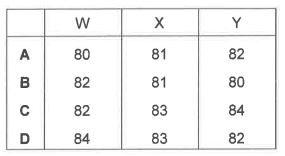
What are the nucleon numbers of W, X and Y?
Video Solution
Explanation
The answer is B (W 82, X 81, Y 80).
\(^{84}_{38}\text{Sr}\) has 38 protons and 84 - 38 = 46 neutrons, so W, X and Y each have 46 neutrons.
\(\text{Sr}^{2+}\) has 38 - 2 = 36 electrons, so W, \(\text{X}^-\) and \(\text{Y}^{2-}\) each have 36 electrons.
• W is a neutral atom: 36 electrons means 36 protons (krypton).
• \(\text{X}^-\) has one electron more than its protons: 36 - 1 = 35 protons (bromine).
• \(\text{Y}^{2-}\) has two electrons more than its protons: 36 - 2 = 34 protons (selenium).
Nucleon number = protons + neutrons:
W = 36 + 46 = 82; X = 35 + 46 = 81; Y = 34 + 46 = 80.
• A (80, 81, 82): reverses W and Y. It would need W to have 34 protons and Y 36, but the neutral atom W must have the most protons of the three.
• C (82, 83, 84): W is right, but X = 83 would need 37 protons and Y = 84 would need 38 protons (strontium), which does not fit 36 electrons in \(\text{X}^-\) and \(\text{Y}^{2-}\).
• D (84, 83, 82): W = 84 would need 38 protons, i.e. W would be strontium itself, and X = 83 would need 37 protons; neither fits 36 electrons.
Want Mr Khemistry to teach you this?
Join a live JC H2 Chemistry class at Bukit Timah, Tampines, or online. Come for a trial lesson, no obligation.
Book a trial classPractice this topic
20+ more Atomic structure questions with shuffled options in ChemBank, free for everyone. Want more? The ChemBank Premium ($100/month) unlocks 4,000+ TYS and Prelim questions, Paper 2 & 3 practice with worked solutions, and all simulations.
Open ChemBank free