2018 H2 Chem P1 Q9 — Thermochemistry Solution
Question
\(CH_4(g) + 2O_2(g) \rightarrow CO_2(g) + 2H_2O(l)\)
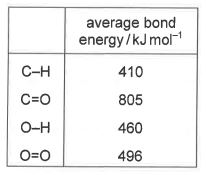
Values of the relevant average bond energies are given in the table.
What is the value for the standard enthalpy change of vaporisation of water?
\(H_2O(l) \rightarrow H_2O(g)\)
Video Solution
Explanation
The answer is C (\(+36\text{ kJ mol}^{-1}\)).
Bond energies are for gaseous species, so they give the enthalpy change with water formed as a gas:
\(\text{CH}_4(\text{g}) + 2\text{O}_2(\text{g}) \rightarrow \text{CO}_2(\text{g}) + 2\text{H}_2\text{O}(\text{g}) \quad \Delta H_1\)
Bonds broken: \(4(\text{C-H}) + 2(\text{O=O}) = 4(410) + 2(496) = 2632\text{ kJ mol}^{-1}\)
Bonds formed: \(2(\text{C=O}) + 4(\text{O-H}) = 2(805) + 4(460) = 3450\text{ kJ mol}^{-1}\)
\(\Delta H_1 = 2632 - 3450 = -818\text{ kJ mol}^{-1}\)
The given \(\Delta H_c = -890\text{ kJ mol}^{-1}\) forms \(2\text{H}_2\text{O}(\text{l})\). By Hess' law, the two routes differ by the step \(2\text{H}_2\text{O}(\text{l}) \rightarrow 2\text{H}_2\text{O}(\text{g})\):
\(2\Delta H_\text{vap} = \Delta H_1 - \Delta H_c = -818 - (-890) = +72\text{ kJ mol}^{-1}\)
\(\Delta H_\text{vap} = \dfrac{+72}{2} = +36\text{ kJ mol}^{-1}\) per mole of water (vaporisation is endothermic, as expected).
• A is wrong: \(-72\) is \(\Delta H_c - \Delta H_1\), the enthalpy change for condensing 2 mol of water, not for vaporising 1 mol.
• B is wrong: \(-36\) has the wrong sign; it is the enthalpy change of condensation of 1 mol of water.
• D is wrong: \(+72\) is for 2 mol of water; it has not been divided by 2.
Want Mr Khemistry to teach you this?
Join a live JC H2 Chemistry class at Bukit Timah, Tampines, or online. Come for a trial lesson, no obligation.
Book a trial classPractice this topic
20+ more Thermochemistry questions with shuffled options in ChemBank, free for everyone. Want more? The ChemBank Premium ($100/month) unlocks 4,000+ TYS and Prelim questions, Paper 2 & 3 practice with worked solutions, and all simulations.
Open ChemBank free