2018 H2 Chem P1 Q30 — Nitrogen Compound Solution
Question
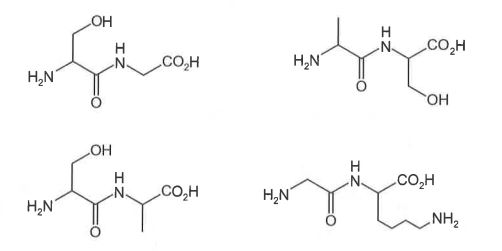
Partial hydrolysis occurs resulting in the production of a mixture of smaller peptides and amino acids, which include the four fragments shown.
What is the formula of the pentapeptide?
Video Solution
Explanation
The answer is D.
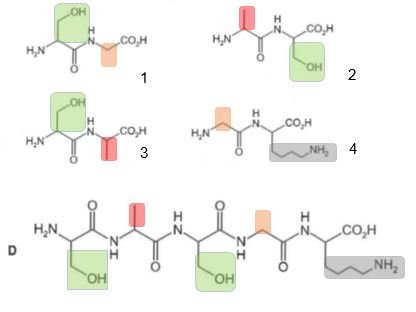
Each fragment shows two amino acids that are next to each other in the chain, read from the \(\text{NH}_2\) end (N-terminus) to the \(\text{CO}_2\text{H}\) end:
• Fragment 1: Ser-Gly (serine, \(\text{CH}_2\text{OH}\) side chain, then glycine)
• Fragment 2: Ala-Ser (alanine, \(\text{CH}_3\) side chain, then serine)
• Fragment 3: Ser-Ala
• Fragment 4: Gly-Lys (lysine, \((\text{CH}_2)_4\text{NH}_2\) side chain)
Linking the overlaps: Ser-Ala (3), Ala-Ser (2), Ser-Gly (1), Gly-Lys (4) gives Ser-Ala-Ser-Gly-Lys, which is pentapeptide D. Its four adjacent pairs are exactly the four fragments.
• A is wrong: A is Ala-Ser-Ser-Gly-Lys. Its adjacent pairs are Ala-Ser, Ser-Ser, Ser-Gly and Gly-Lys, so it cannot give fragment 3 (Ser-Ala).
• B is wrong: B is Ser-Gly-Lys-Ala-Gly. Its pairs are Ser-Gly, Gly-Lys, Lys-Ala and Ala-Gly, so it cannot give fragment 2 (Ala-Ser) or fragment 3 (Ser-Ala).
• C is wrong: C is Ala-Ser-Gly-Lys-Gly. Its pairs are Ala-Ser, Ser-Gly, Gly-Lys and Lys-Gly, so it cannot give fragment 3 (Ser-Ala).
Want Mr Khemistry to teach you this?
Join a live JC H2 Chemistry class at Bukit Timah, Tampines, or online. Come for a trial lesson, no obligation.
Book a trial classPractice this topic
20+ more Nitrogen Compound questions with shuffled options in ChemBank, free for everyone. Want more? The ChemBank Premium ($100/month) unlocks 4,000+ TYS and Prelim questions, Paper 2 & 3 practice with worked solutions, and all simulations.
Open ChemBank free