2018 H2 Chem P1 Q3 — Chemical bonding Solution
Question
Which molecules are polar?
\(1 \quad CSe_2\)
\(2 \quad SeCl_2\)
\(3 \quad CCl_4\)
Video Solution
Explanation
The answer is D (2 only).
A molecule is polar only if it has polar bonds whose dipoles do not cancel. All the bonds here are polar because the electronegativities are different, so the shape decides.
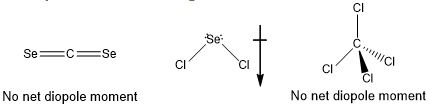
• 1, \(\text{CSe}_2\): C has two double bonds and no lone pair, so the molecule is linear (Se=C=Se, 180°). The two equal C=Se dipoles point in opposite directions and cancel, so it is non-polar.
• 2, \(\text{SeCl}_2\): Se has 2 bond pairs and 2 lone pairs, so the molecule is bent (like water). The two Se-Cl dipoles do not cancel and there is a resultant dipole, so it is polar.
• 3, \(\text{CCl}_4\): C has 4 bond pairs and no lone pair, so the molecule is tetrahedral. The four equal C-Cl dipoles cancel, so it is non-polar.
Only molecule 2 is polar.
• A (1 and 3) is wrong: both \(\text{CSe}_2\) and \(\text{CCl}_4\) are symmetrical and non-polar.
• B (1 only) is wrong: linear \(\text{CSe}_2\) is non-polar, and it leaves out the polar \(\text{SeCl}_2\).
• C (2 and 3) is wrong: tetrahedral \(\text{CCl}_4\) is non-polar.
Want Mr Khemistry to teach you this?
Join a live JC H2 Chemistry class at Bukit Timah, Tampines, or online. Come for a trial lesson, no obligation.
Book a trial classPractice this topic
20+ more Chemical bonding questions with shuffled options in ChemBank, free for everyone. Want more? The ChemBank Premium ($100/month) unlocks 4,000+ TYS and Prelim questions, Paper 2 & 3 practice with worked solutions, and all simulations.
Open ChemBank free