2018 H2 Chem P1 Q29 — Nitrogen Compound Solution
Question
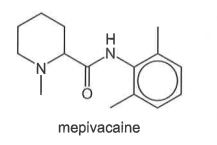
What are the products when mepivacaine is hydrolysed by heating with NaOH(aq)?
Video Solution
Explanation
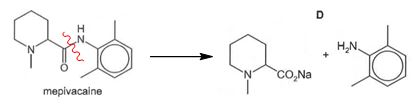
The answer is D.
Mepivacaine has one hydrolysable group, the amide -CO-NH-. Heating with NaOH(aq) breaks the amide C-N bond. The acyl part becomes the sodium carboxylate (the carboxylic acid is formed in alkaline solution, so it reacts with NaOH at once), and the nitrogen part is released as the free amine, 2,6-dimethylphenylamine. The ring tertiary amine N-\(\text{CH}_3\) is unchanged.
Products: the ring compound with \(\text{-CO}_2\text{Na}\) and \(\text{H}_2\text{N-C}_6\text{H}_3(\text{CH}_3)_2\), as in D.
• A is wrong: it breaks the C-C bond between the ring and the carbonyl carbon, which is not hydrolysed, and leaves the amide C-N bond intact; the ring carbon cannot become an alcohol carbon.
• B is wrong: the bond broken is correct, but in excess NaOH(aq) the carboxylic acid is deprotonated, so the product is the sodium salt, \(\text{-CO}_2\text{Na}\), not \(\text{-CO}_2\text{H}\).
• C is wrong: hydrolysis does not change the oxidation state of the carbonyl carbon, so it gives a carboxylate, not an aldehyde, -CHO.
Want Mr Khemistry to teach you this?
Join a live JC H2 Chemistry class at Bukit Timah, Tampines, or online. Come for a trial lesson, no obligation.
Book a trial classPractice this topic
20+ more Nitrogen Compound questions with shuffled options in ChemBank, free for everyone. Want more? The ChemBank Premium ($100/month) unlocks 4,000+ TYS and Prelim questions, Paper 2 & 3 practice with worked solutions, and all simulations.
Open ChemBank free