2018 H2 Chem P1 Q26 — Carboxylic Acid Solution
Question
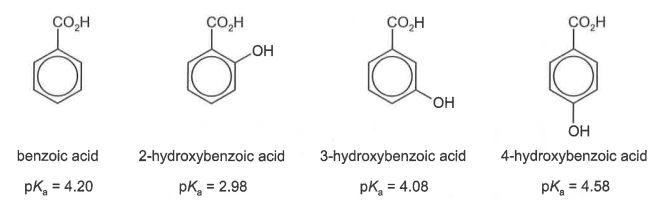
Why is 2-hydroxybenzoic acid so much more acidic than 4-hydroxybenzoic acid?
Video Solution
Explanation
The answer is B.
The more stable the conjugate base, the stronger the acid. 2-hydroxybenzoic acid (\(\text{p}K_\text{a} = 2.98\)) is much more acidic than 4-hydroxybenzoic acid (\(\text{p}K_\text{a} = 4.58\)).
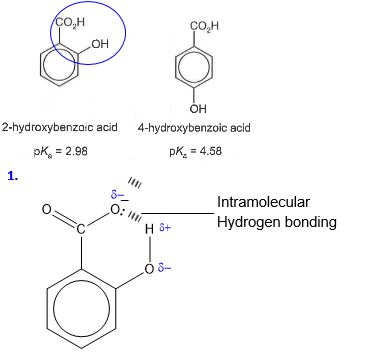
In the 2-hydroxybenzoate ion, the OH group is next to the \(\text{CO}_2^-\) group, so the H of the OH forms an intramolecular hydrogen bond to a negatively charged O of the carboxylate. This extra attraction to the negatively charged carboxylate group stabilises the conjugate base, so the acid dissociates more. In 4-hydroxybenzoate the OH is too far from the \(\text{CO}_2^-\) group for this to happen.
• A is wrong: hydrogen bonding between a pair of acid molecules involves the undissociated acid, not the conjugate base, so it does not stabilise the anion; 4-hydroxybenzoic acid can also hydrogen bond intermolecularly.
• C is wrong: the OH group is electron-donating to the ring (a lone pair on O is delocalised into the ring), which destabilises the carboxylate ion. That is why 4-hydroxybenzoic acid (4.58) is weaker than benzoic acid (4.20).
• D is wrong: the negative charge of every carboxylate ion is delocalised over its two oxygen atoms, including 4-hydroxybenzoate and benzoate, so this cannot explain the difference between the two isomers.
Want Mr Khemistry to teach you this?
Join a live JC H2 Chemistry class at Bukit Timah, Tampines, or online. Come for a trial lesson, no obligation.
Book a trial classPractice this topic
20+ more Carboxylic Acid questions with shuffled options in ChemBank, free for everyone. Want more? The ChemBank Premium ($100/month) unlocks 4,000+ TYS and Prelim questions, Paper 2 & 3 practice with worked solutions, and all simulations.
Open ChemBank free