2018 H2 Chem P1 Q24 — Hydroxyl Compounds Solution
Question
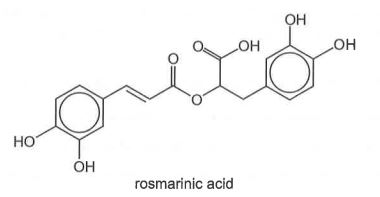
How many moles of NaOH(aq) will react with one mole of rosmarinic acid when the acid is heated under reflux with an excess of NaOH(aq)?
Video Solution
Explanation
The answer is D (6).
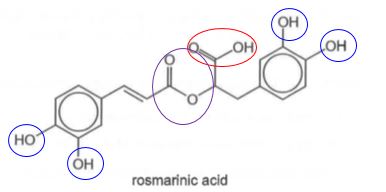
Hot excess NaOH(aq) reacts with every acidic group and hydrolyses every ester group. Rosmarinic acid has:
• 4 phenolic OH groups (two on each benzene ring): 4 mol NaOH, \(\text{ArOH} + \text{NaOH} \rightarrow \text{ArO}^-\text{Na}^+ + \text{H}_2\text{O}\)
• 1 carboxylic acid group: 1 mol NaOH, \(\text{RCO}_2\text{H} + \text{NaOH} \rightarrow \text{RCO}_2^-\text{Na}^+ + \text{H}_2\text{O}\)
• 1 ester group, hydrolysed on heating: 1 mol NaOH, \(\text{RCO}_2\text{R'} + \text{NaOH} \rightarrow \text{RCO}_2^-\text{Na}^+ + \text{R'OH}\)
Total = 4 + 1 + 1 = 6 mol NaOH per mole of rosmarinic acid. The alcohol R'OH released by the hydrolysis is not acidic enough to react with NaOH.
• A (1) is wrong: it counts only the carboxylic acid group.
• B (2) is wrong: it counts the carboxylic acid and the ester but misses the four phenol groups.
• C (5) is wrong: it counts the carboxylic acid and the four phenol groups but misses the ester hydrolysis.
Want Mr Khemistry to teach you this?
Join a live JC H2 Chemistry class at Bukit Timah, Tampines, or online. Come for a trial lesson, no obligation.
Book a trial classPractice this topic
20+ more Hydroxyl Compounds questions with shuffled options in ChemBank, free for everyone. Want more? The ChemBank Premium ($100/month) unlocks 4,000+ TYS and Prelim questions, Paper 2 & 3 practice with worked solutions, and all simulations.
Open ChemBank free