2018 H2 Chem P1 Q21 — Introduction to Organic Solution
Question
Video Solution
Explanation
The answer is C.
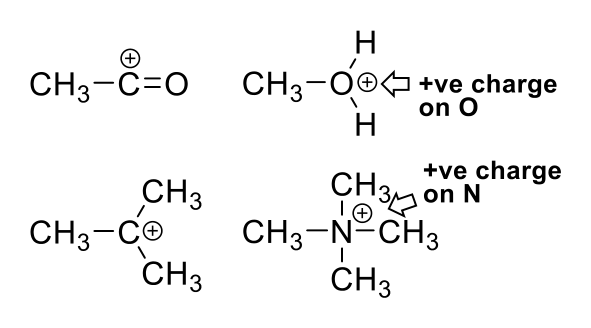
A carbocation is a positive ion in which the positive charge sits on a carbon atom.
• \([\text{CH}_3\text{CO}]^+\) (the acylium ion, \(\text{CH}_3\text{-}\overset{+}{\text{C}}\text{=O}\)): the positive charge is on the carbonyl carbon, so it is a carbocation.
• \([(\text{CH}_3)_3\text{C}]^+\): the positive charge is on the central carbon bonded to three methyl groups (a tertiary carbocation).
• \([\text{CH}_3\text{OH}_2]^+\): oxygen has formed a third bond (to an extra \(\text{H}^+\)), so the positive charge is on O, not C.
• \([(\text{CH}_3)_4\text{N}]^+\): nitrogen has formed four bonds, so the positive charge is on N (a quaternary ammonium ion), not C.
• A is wrong: \([\text{CH}_3\text{OH}_2]^+\) has its positive charge on oxygen.
• B is wrong: \([(\text{CH}_3)_4\text{N}]^+\) has its positive charge on nitrogen.
• D is wrong: neither species is a carbocation; the charges are on N and O.
Want Mr Khemistry to teach you this?
Join a live JC H2 Chemistry class at Bukit Timah, Tampines, or online. Come for a trial lesson, no obligation.
Book a trial classPractice this topic
20+ more Introduction to Organic questions with shuffled options in ChemBank, free for everyone. Want more? The ChemBank Premium ($100/month) unlocks 4,000+ TYS and Prelim questions, Paper 2 & 3 practice with worked solutions, and all simulations.
Open ChemBank free