2018 H2 Chem P1 Q2 — Chemical bonding Solution
Question
\(Al_2Cl_6(g) \rightleftharpoons 2AlCl_3(g)\)
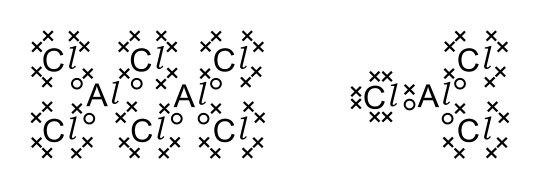
Which diagram correctly describes the bonding in both \(Al_2Cl_6\) and \(AlCl_3\)?
Video Solution
Explanation
The answer is D.
Both \(\text{Al}_2\text{Cl}_6\) and gaseous \(\text{AlCl}_3\) are simple covalent molecules.
• In \(\text{AlCl}_3\), Al forms three covalent bonds to Cl and has only 6 electrons in its valence shell, so it is electron-deficient.
• In \(\text{Al}_2\text{Cl}_6\), each bridging Cl donates a lone pair into the empty orbital of the other Al atom, forming two dative bonds. A dative arrow points from the donor (Cl) to the acceptor (Al).
In D both dative arrows point from the bridging Cl to Al, and \(\text{AlCl}_3\) is drawn as a covalent molecule.
• A is wrong: the dative arrows point from Al to Cl, and \(\text{AlCl}_3\) is drawn as ionic \(\text{Al}^{3+}3\text{Cl}^-\).
• B is wrong: the dimer is correct, but \(\text{AlCl}_3\) is drawn as ionic. The small, highly charged \(\text{Al}^{3+}\) polarises the electron cloud of \(\text{Cl}^-\) so strongly that the bonding is covalent.
• C is wrong: \(\text{AlCl}_3\) is correct, but the dative arrows point from Al to Cl. Al has no lone pair to donate; it is the acceptor.
Want Mr Khemistry to teach you this?
Join a live JC H2 Chemistry class at Bukit Timah, Tampines, or online. Come for a trial lesson, no obligation.
Book a trial classPractice this topic
20+ more Chemical bonding questions with shuffled options in ChemBank, free for everyone. Want more? The ChemBank Premium ($100/month) unlocks 4,000+ TYS and Prelim questions, Paper 2 & 3 practice with worked solutions, and all simulations.
Open ChemBank free