2018 H2 Chem P1 Q17 — Electrochemical cell Solution
Question
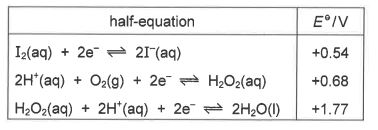
Some relevant redox half-equations are given in the table.
What do the \(E^\circ\) values shown in the table predict will be observed when a few drops of acidified aqueous hydrogen peroxide are added to an excess of aqueous potassium iodide?
Video Solution
Explanation
The answer is B (the solution turns brown without effervescence).
\(\text{H}_2\text{O}_2\) oxidises \(\text{I}^-\) to \(\text{I}_2\):
\(\text{H}_2\text{O}_2 + 2\text{H}^+ + 2\text{I}^- \rightarrow \text{I}_2 + 2\text{H}_2\text{O}\)
\(E^\ominus_\text{cell} = E^\ominus(\text{H}_2\text{O}_2/\text{H}_2\text{O}) - E^\ominus(\text{I}_2/\text{I}^-) = +1.77 - (+0.54) = +1.23\text{ V}\), which is positive, so the reaction is feasible.
With the excess \(\text{I}^-\), the \(\text{I}_2\) formed gives \(\text{I}_3^-\) (\(\text{I}_2 + \text{I}^- \rightleftharpoons \text{I}_3^-\)), so the solution turns brown.
Effervescence would need \(\text{H}_2\text{O}_2\) to be oxidised to \(\text{O}_2\). The few drops of \(\text{H}_2\text{O}_2\) are used up by the excess \(\text{I}^-\), and \(\text{I}_2\) cannot oxidise \(\text{H}_2\text{O}_2\):
\(\text{I}_2 + \text{H}_2\text{O}_2 \rightarrow \text{O}_2 + 2\text{H}^+ + 2\text{I}^-\)
\(E^\ominus_\text{cell} = E^\ominus(\text{I}_2/\text{I}^-) - E^\ominus(\text{O}_2/\text{H}_2\text{O}_2) = +0.54 - (+0.68) = -0.14\text{ V}\), which is negative, so this is not feasible and no gas is given off.
• A is wrong: no \(\text{O}_2\) is formed, so there is no effervescence.
• C is wrong: iodine is purple only when dissolved in a non-polar organic solvent; in aqueous KI it is brown. There is also no effervescence.
• D is wrong: the solution is brown, not purple, for the same reason.
Want Mr Khemistry to teach you this?
Join a live JC H2 Chemistry class at Bukit Timah, Tampines, or online. Come for a trial lesson, no obligation.
Book a trial classPractice this topic
20+ more Electrochemical cell questions with shuffled options in ChemBank, free for everyone. Want more? The ChemBank Premium ($100/month) unlocks 4,000+ TYS and Prelim questions, Paper 2 & 3 practice with worked solutions, and all simulations.
Open ChemBank free