2017 H2 Chem P1 Q6 — Acid base equilibrium Solution
Question
Video Solution
Explanation
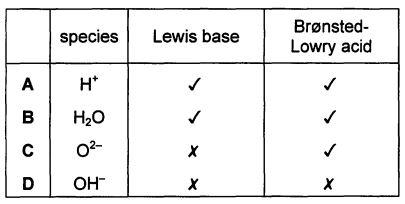
The answer is B (\(\text{H}_2\text{O}\): Lewis base ✓, Brønsted-Lowry acid ✓).
A Lewis base is an electron-pair donor. A Brønsted-Lowry acid is a proton (\(\text{H}^+\)) donor.
\(\text{H}_2\text{O}\) can donate a lone pair on O (for example to \(\text{H}^+\) to form \(\text{H}_3\text{O}^+\)), so it is a Lewis base, and it can donate \(\text{H}^+\) (for example to \(\text{NH}_3\)), so it is a Brønsted-Lowry acid. Both ticks are correct.
• A is wrong: \(\text{H}^+\) has no electrons, so it has no lone pair to donate and cannot be a Lewis base. It is an electron-pair acceptor (a Lewis acid).
• C is wrong: \(\text{O}^{2-}\) has lone pairs and is an electron-pair donor, so it IS a Lewis base (the cross is wrong). It has no H atom, so it cannot donate \(\text{H}^+\) and is not a Brønsted-Lowry acid (the tick is wrong); it is an \(\text{H}^+\) acceptor, a Brønsted-Lowry base.
• D is wrong: \(\text{OH}^-\) donates a lone pair to \(\text{H}^+\) to form \(\text{H}_2\text{O}\), so it IS a Lewis base and the cross in the Lewis base column is wrong. Its cross in the Brønsted-Lowry acid column is correct, because \(\text{OH}^-\) acts as an \(\text{H}^+\) acceptor (a Brønsted-Lowry base), not an \(\text{H}^+\) donor.
Want Mr Khemistry to teach you this?
Join a live JC H2 Chemistry class at Bukit Timah, Tampines, or online. Come for a trial lesson, no obligation.
Book a trial classPractice this topic
20+ more Acid base equilibrium questions with shuffled options in ChemBank, free for everyone. Want more? The ChemBank Premium ($100/month) unlocks 4,000+ TYS and Prelim questions, Paper 2 & 3 practice with worked solutions, and all simulations.
Open ChemBank free