2017 H2 Chem P1 Q30 — Electrochemical cell Solution
Question
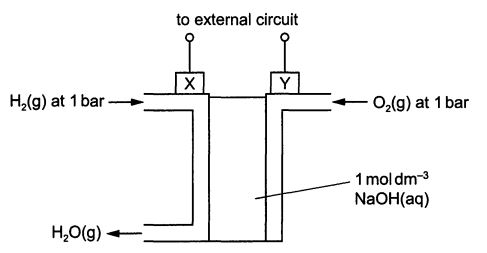
A hydrogen-oxygen fuel cell is shown. In which direction do the electrons flow in the external circuit and which \(E^\circ\) value should be used for the oxygen electrode?
Video Solution
Explanation
The answer is A (X to Y; 0.40 V).
The electrolyte is 1 mol \(\text{dm}^{-3}\) NaOH(aq), so both electrodes use the half-equations for alkaline conditions (Data Booklet values):
Hydrogen electrode X: \(2\text{H}_2\text{O} + 2\text{e}^- \rightleftharpoons \text{H}_2 + 2\text{OH}^-\), \(E^\circ = -0.83\) V. \(\text{H}_2\) is oxidised here: \(\text{H}_2 + 2\text{OH}^- \rightarrow 2\text{H}_2\text{O} + 2\text{e}^-\), so X is the anode (negative electrode).
Oxygen electrode Y: \(\text{O}_2 + 2\text{H}_2\text{O} + 4\text{e}^- \rightleftharpoons 4\text{OH}^-\), \(E^\circ = +0.40\) V. \(\text{O}_2\) is reduced here, so Y is the cathode (positive electrode).
Electrons are released at X and consumed at Y, so in the external circuit they flow from X to Y. (\(E^\circ_\text{cell} = 0.40 - (-0.83) = +1.23\) V.)
• B is wrong: the direction is right, but 1.23 V is \(E^\circ\) for \(\text{O}_2 + 4\text{H}^+ + 4\text{e}^- \rightleftharpoons 2\text{H}_2\text{O}\), the oxygen electrode in acidic conditions. The electrolyte here is alkaline NaOH(aq).
• C is wrong: the \(E^\circ\) value is right, but electrons flow from the anode X, where \(\text{H}_2\) is oxidised, to the cathode Y, not from Y to X.
• D is wrong: both entries are wrong. Electrons flow from X to Y, and the alkaline oxygen electrode has \(E^\circ = +0.40\) V, not 1.23 V.
Want Mr Khemistry to teach you this?
Join a live JC H2 Chemistry class at Bukit Timah, Tampines, or online. Come for a trial lesson, no obligation.
Book a trial classPractice this topic
20+ more Electrochemical cell questions with shuffled options in ChemBank, free for everyone. Want more? The ChemBank Premium ($100/month) unlocks 4,000+ TYS and Prelim questions, Paper 2 & 3 practice with worked solutions, and all simulations.
Open ChemBank free