2017 H2 Chem P1 Q3 — Chemical bonding Solution
Question
Video Solution
Explanation
The answer is D (120°).
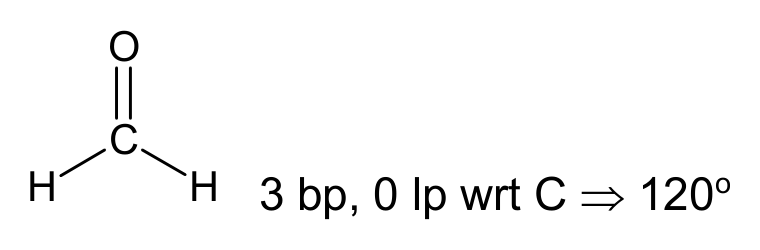
In methanal, HCHO, the central carbon forms two C-H bonds and one C=O double bond and has no lone pair. A double bond counts as one region of electron density, so there are 3 bonding regions and 0 lone pairs around C. These repel to be as far apart as possible, giving a trigonal planar shape with bond angles of 120° (the carbon is \(\text{sp}^2\) hybridised).
• A is wrong: 104.5° is the bond angle for 2 bond pairs and 2 lone pairs (bent, as in \(\text{H}_2\text{O}\)). The carbon in methanal has no lone pairs.
• B is wrong: 107° is the bond angle for 3 bond pairs and 1 lone pair (trigonal pyramidal, as in \(\text{NH}_3\)). The carbon has no lone pair.
• C is wrong: 109.5° is the tetrahedral angle for 4 bond pairs (as in \(\text{CH}_4\)). It results from counting the C=O double bond as two regions of electron density instead of one.
Want Mr Khemistry to teach you this?
Join a live JC H2 Chemistry class at Bukit Timah, Tampines, or online. Come for a trial lesson, no obligation.
Book a trial classPractice this topic
20+ more Chemical bonding questions with shuffled options in ChemBank, free for everyone. Want more? The ChemBank Premium ($100/month) unlocks 4,000+ TYS and Prelim questions, Paper 2 & 3 practice with worked solutions, and all simulations.
Open ChemBank free