2017 H2 Chem P1 Q27 — Halogenoalkane Solution
Question
The rate of reaction can be increased by using a solvent which is polar but does not form any by-products. Which solvent should be used?
Video Solution
Explanation
The answer is A (\(\text{H}_2\text{O}\)).
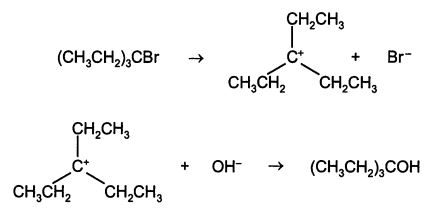
The \(\text{S}_\text{N}1\) rate-determining step is ionisation of \((\text{CH}_3\text{CH}_2)_3\text{CBr}\) into a carbocation and \(\text{Br}^-\). A polar solvent stabilises these ions and speeds up this step. However, the carbocation is highly electrophilic, so any solvent molecule with a lone pair can attack it and form an adduct.
Water is polar. When it attacks the carbocation (and loses \(\text{H}^+\)) it gives \((\text{CH}_3\text{CH}_2)_3\text{COH}\), the same product as from \(\text{OH}^-\), so no by-product forms.
• B is wrong: hexane, \(\text{C}_6\text{H}_{14}\), is non-polar. It does not stabilise the carbocation and \(\text{Br}^-\), so it does not increase the rate.
• C is wrong: ethylamine is polar, but its N lone pair makes it a nucleophile. It attacks the carbocation to give the by-product \((\text{CH}_3\text{CH}_2)_3\text{C-NHCH}_2\text{CH}_3\).
• D is wrong: ethanol is polar, but its O lone pair attacks the carbocation to give the ether by-product \((\text{CH}_3\text{CH}_2)_3\text{C-OCH}_2\text{CH}_3\).
Want Mr Khemistry to teach you this?
Join a live JC H2 Chemistry class at Bukit Timah, Tampines, or online. Come for a trial lesson, no obligation.
Book a trial classPractice this topic
20+ more Halogenoalkane questions with shuffled options in ChemBank, free for everyone. Want more? The ChemBank Premium ($100/month) unlocks 4,000+ TYS and Prelim questions, Paper 2 & 3 practice with worked solutions, and all simulations.
Open ChemBank free