2017 H2 Chem P1 Q23 — Halogenoalkane Solution
Question
Video Solution
Explanation
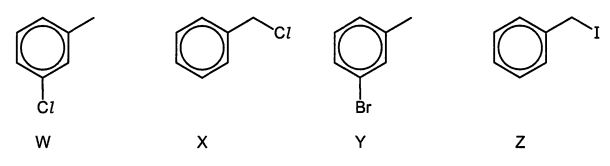
The answer is D (W and Y; yellow).
The halogenoalkane is hydrolysed in the hot ethanolic silver nitrate, and the halide ion released forms a silver halide precipitate.
W (Cl on the ring) and Y (Br on the ring) are halogenoarenes. The p orbital of the halogen overlaps with the \(\pi\) electron cloud of the benzene ring, giving the C-X bond partial double bond character, so it is too strong to break and no precipitate forms.
X (\(\text{C}_6\text{H}_5\text{CH}_2\text{Cl}\)) and Z (\(\text{C}_6\text{H}_5\text{CH}_2\text{I}\)) have the halogen on a side-chain carbon, so they react like halogenoalkanes. The C-I bond in Z is longer and weaker than the C-Cl bond in X, so Z reacts faster, giving the yellow precipitate AgI first (X later gives white AgCl).
• A is wrong: X does form a precipitate, because its Cl is on the side-chain \(\text{CH}_2\) and not on the ring. Cream is the colour of AgBr, but the Br compound Y does not react.
• B is wrong: X does form a precipitate (its Cl is on a side-chain carbon), so the two unreactive compounds are W and Y, not W and X.
• C is wrong: white AgCl comes from X, which reacts more slowly than Z because the C-Cl bond is stronger than the C-I bond. The fastest precipitate is yellow AgI.
Want Mr Khemistry to teach you this?
Join a live JC H2 Chemistry class at Bukit Timah, Tampines, or online. Come for a trial lesson, no obligation.
Book a trial classPractice this topic
20+ more Halogenoalkane questions with shuffled options in ChemBank, free for everyone. Want more? The ChemBank Premium ($100/month) unlocks 4,000+ TYS and Prelim questions, Paper 2 & 3 practice with worked solutions, and all simulations.
Open ChemBank free