2017 H2 Chem P1 Q22 — Arene Solution
Question
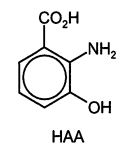
What is the product of the reaction of HAA with an excess of ethanoyl chloride?
Video Solution
Explanation
The answer is A.
HAA has three functional groups: \(-\text{CO}_2\text{H}\), \(-\text{NH}_2\) (a phenylamine group) and \(-\text{OH}\) (a phenol group). Ethanoyl chloride acylates both the \(-\text{NH}_2\) and \(-\text{OH}\) groups in condensation reactions, releasing HCl:
\(\text{R-NH}_2 + \text{CH}_3\text{COCl} \rightarrow \text{R-NHCOCH}_3 + \text{HCl}\) (amide)
\(\text{Ar-OH} + \text{CH}_3\text{COCl} \rightarrow \text{Ar-OCOCH}_3 + \text{HCl}\) (ester)
With an excess of ethanoyl chloride both groups react, giving A, which has \(-\text{NHCOCH}_3\) and \(-\text{OCOCH}_3\) with the \(-\text{CO}_2\text{H}\) group unchanged.
• B is wrong: only the phenol has been acylated and the \(-\text{NH}_2\) group is unchanged. The amine group is a better nucleophile than the phenol and, with excess ethanoyl chloride, it is also converted to the amide.
• C is wrong: the phenol OH has been replaced by Cl. Ethanoyl chloride acylates a phenol to form an ester; it does not substitute Cl for OH.
• D is wrong: the \(-\text{CO}_2\text{H}\) group has been turned into \(-\text{COCl}\) while \(-\text{NH}_2\) and \(-\text{OH}\) are unchanged. Converting a carboxylic acid into an acyl chloride needs a reagent such as \(\text{PCl}_5\) or \(\text{SOCl}_2\), and the \(-\text{NH}_2\) and \(-\text{OH}\) groups, which do react with ethanoyl chloride, would not be left unchanged.
Want Mr Khemistry to teach you this?
Join a live JC H2 Chemistry class at Bukit Timah, Tampines, or online. Come for a trial lesson, no obligation.
Book a trial classPractice this topic
20+ more Arene questions with shuffled options in ChemBank, free for everyone. Want more? The ChemBank Premium ($100/month) unlocks 4,000+ TYS and Prelim questions, Paper 2 & 3 practice with worked solutions, and all simulations.
Open ChemBank free