2017 H2 Chem P1 Q19 — Introduction to Organic Solution
Question
Video Solution
Explanation
The answer is A (butanone + HCN).
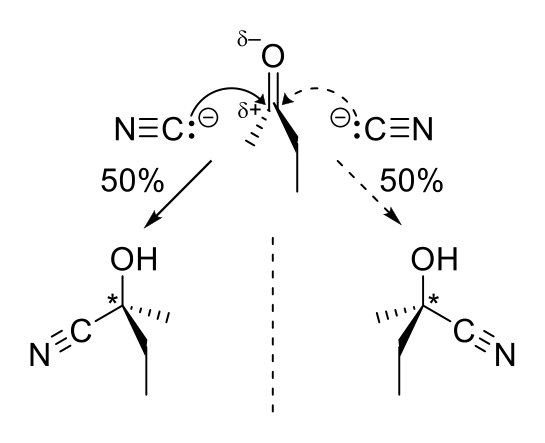
Butanone is a ketone. HCN adds to the C=O group by nucleophilic addition. The carbonyl carbon is trigonal planar, so the \(\text{CN}^-\) nucleophile attacks it from either face with equal probability (50% each, as shown in the figure).
The product, 2-hydroxy-2-methylbutanenitrile, has a chiral carbon bonded to four different groups (\(\text{CH}_3\), \(\text{C}_2\text{H}_5\), OH and CN). Attack from the two faces gives the two enantiomers in equal amounts, a racemic mixture.
• B is wrong: the Cl is on a primary carbon (\(\text{CH}_2\text{C}l\)), which undergoes \(\text{S}_\text{N}2\) to give \(\text{CH}_2\text{OH}\). This carbon has 2 H atoms, so it is not a chiral centre. The neighbouring chiral carbon (bonded to \(\text{CH}_3\), \(\text{C}_2\text{H}_5\), the pentyl chain and \(\text{CH}_2\text{C}l\)) is not involved in the reaction, so its configuration is unchanged and a single enantiomer is formed.
• C is wrong: the tertiary carbon bearing Cl is bonded to \(\text{CH}_3\) and two ethyl groups (the \(\text{C}_2\text{H}_5\) and the ethyl chain drawn on the left). It reacts by \(\text{S}_\text{N}1\) through a planar carbocation, but the product carbon still carries two identical ethyl groups, so it is not chiral and no enantiomers form.
• D is wrong: the tertiary carbon bearing Cl is bonded to two \(\text{CH}_3\) groups, so the \(\text{S}_\text{N}1\) product carbon is not chiral and no enantiomers form.
Want Mr Khemistry to teach you this?
Join a live JC H2 Chemistry class at Bukit Timah, Tampines, or online. Come for a trial lesson, no obligation.
Book a trial classPractice this topic
20+ more Introduction to Organic questions with shuffled options in ChemBank, free for everyone. Want more? The ChemBank Premium ($100/month) unlocks 4,000+ TYS and Prelim questions, Paper 2 & 3 practice with worked solutions, and all simulations.
Open ChemBank free