
Fascinating Chemical Reactions Students Should Know About

Key Takeaways
- Interesting chemical reactions can make abstract Chemistry concepts easier to understand by showing visible changes such as colour, foam, light and gas production.
- Experiments such as the Blue Bottle Reaction, elephant toothpaste and flame tests demonstrate topics including redox, decomposition, catalysis and energy changes.
- Everyday processes such as baking and rusting show that chemical reactions are happening around you all the time.
- Connecting topics to familiar examples, visual demonstrations and common reaction patterns can make revision more engaging and memorable.
- A good Chemistry tutor should use clear explanations, experiments and guided practice to help you understand why reactions happen and apply them confidently in exams.
Introduction
Chemistry is not just about memorising formulas or balancing equations. It is also about watching a solution change colour, seeing foam rise from a container, or discovering why a flame burns in a completely different shade.
These reactions may look impressive, but they also help you understand what is happening between particles. By exploring these interesting chemical reactions, you can start to see Chemistry as something happening all around you, not just a subject you study for an exam.
6 Interesting Chemical Reactions That Make Chemistry Come Alive
1. The Blue Bottle Reaction
The Blue Bottle Reaction uses glucose, sodium hydroxide and methylene blue, a dye that can switch between blue and colourless forms.
When the solution is left to stand, glucose gives electrons to the methylene blue. This reduces the dye, turning it into colourless leucomethylene blue, so the blue colour slowly fades. Once you shake the bottle, oxygen from the air dissolves into the solution, changing the dye back to its oxidised blue form.
This experiment is a great example of how chemical reactions, like oxidation and reduction, can happen together. Glucose is oxidised, while the dye is reduced and then oxidised again by oxygen.
2. Elephant Toothpaste
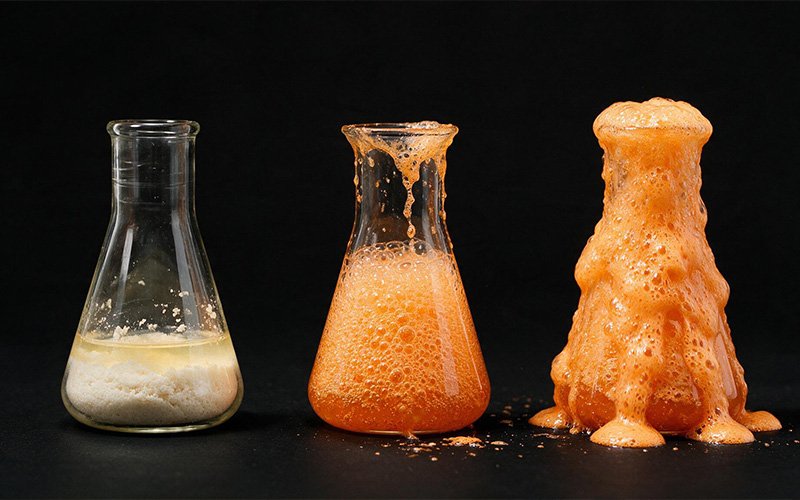
Despite the name, this experiment has nothing to do with brushing an elephant’s teeth. It gets its nickname from the thick foam that quickly rises out of the container.
In this experiment, hydrogen peroxide decomposes into water and oxygen:
2H₂O₂ → 2H₂O + O₂
A catalyst such as potassium iodide or manganese(IV) oxide speeds up the reaction. When detergent is added, the oxygen becomes trapped in bubbles, creating a large column of foam.
This reaction helps you understand decomposition, catalysts, gas production and exothermic reactions. It should only be carried out under teacher supervision.
3. Flame Test Reactions
Have you ever wondered why fireworks appear in different colours? A flame test is an interesting chemical reaction that can help explain it.
When metal ions are heated, their electrons absorb energy. As the electrons return to lower energy levels, they release that energy as coloured light. For example, sodium ions produce a bright yellow flame, potassium ions produce a lilac flame, and copper compounds may produce a blue-green flame.
4. Vinegar and Baking Soda
You have probably seen vinegar and baking soda used to create a model volcano. The dramatic fizzing happens because a gas is being produced.
Vinegar contains ethanoic acid, while baking soda is sodium hydrogencarbonate. When they react, they form sodium ethanoate, water and carbon dioxide:
CH₃COOH + NaHCO₃ → CH₃COONa + CO₂ + H₂O
The carbon dioxide escapes as bubbles, creating the fizzing effect. Similar real-life chemistry reactions happen when acidic ingredients react with raising agents during baking.
5. Rusting of Iron
Rusting may happen much more slowly than the other reactions on this list, but you have probably seen its effects on bicycles, railings or metal tools. Essentially, iron rusts when it reacts with oxygen and water to form hydrated iron(III) oxide:
4Fe + 3O₂ + xH₂O → 2Fe₂O₃·xH₂O
Singapore’s humid weather makes this reaction especially easy to observe. Rusting also explains why metal objects are often painted or galvanised. These protective layers stop oxygen and water from reaching the iron.
6. The Hydrogen “Pop” Test
The hydrogen pop test is a quick way to identify hydrogen gas in the laboratory.
When a lighted splint is placed near the opening of a test tube containing hydrogen, the gas reacts rapidly with oxygen:
2H₂ + O₂ → 2H₂O
The reaction produces a small but distinctive “pop” sound. It is a simple way to see combustion and the rapid release of heat energy in action. However, this test must be performed carefully under proper supervision.
How to Make Learning Chemistry More Interesting
Once you start seeing Chemistry in action, it becomes much easier to understand why the subject matters. You can make learning and revising Chemistry concepts more fun by trying a few simple approaches:
- Connect each topic to something familiar. Link redox reactions to batteries, acids and bases to cleaning products or gas-producing reactions to baking.
- Use visual learning. Watch short experiment videos, draw particle diagrams or sketch the stages of a reaction instead of relying only on written notes.
- Turn reactions into patterns. Group similar reactions together, such as acids with metals, carbonates or bases, so you can compare the products and observations.
- Ask questions that go beyond the textbook. Find out why fireworks have different colours, why apples turn brown, or how glow sticks produce light, then connect the answer to a topic you are studying.
See the Bigger Picture with Mr Khemistry
Reading about these interesting chemical reactions is one thing, but seeing them happen makes them even more memorable. If you would like to watch more fascinating demonstrations, check out Mr Khemistry’s TikTok videos, where our tutors bring classroom concepts to life through experiments and simple explanations.
<embed>
If those experiments spark your curiosity, our Chemistry tuition lessons are designed to take you one step further. Instead of simply memorising equations, you will learn why reactions happen, recognise patterns across different topics and apply your understanding to unfamiliar exam questions.
Whether you are preparing for O-Level, IP or A-Level Chemistry, lessons are aligned with the MOE Singapore syllabus and supported by guided practice and personalised feedback. By building understanding first, our friendly Chemistry tutors are here to help you approach Chemistry with greater confidence, both in the classroom and in your exams.
Contact us to find a class for you today.
Frequently Asked Questions
Q1: What should I pay attention to when watching a chemical reaction?
Do not focus only on the most dramatic effect. Look for changes in colour, temperature, smell, state and the formation of bubbles or a solid. Write down what you observe before deciding what type of reaction may have occurred. This trains you to notice the details commonly tested in practical questions.
Q2: How can I use reaction demonstration videos for revision?
Pause the video before the reaction begins and predict what you expect to see. After watching it, compare the result with your prediction, then write the relevant equation and explain the observation. This turns an entertaining demonstration into active revision rather than passive watching.
Q3: Can I recreate interesting chemical reactions at home?
Only try reactions that use safe household materials and do not involve flames, concentrated chemicals, sealed containers or unknown substances. Reactions such as elephant toothpaste and the hydrogen pop test should be carried out in a properly equipped laboratory under teacher supervision. When unsure, watch a trusted demonstration instead of attempting it yourself.