
Arenes Concept Map

Exploring Arenes: Properties and Reactions
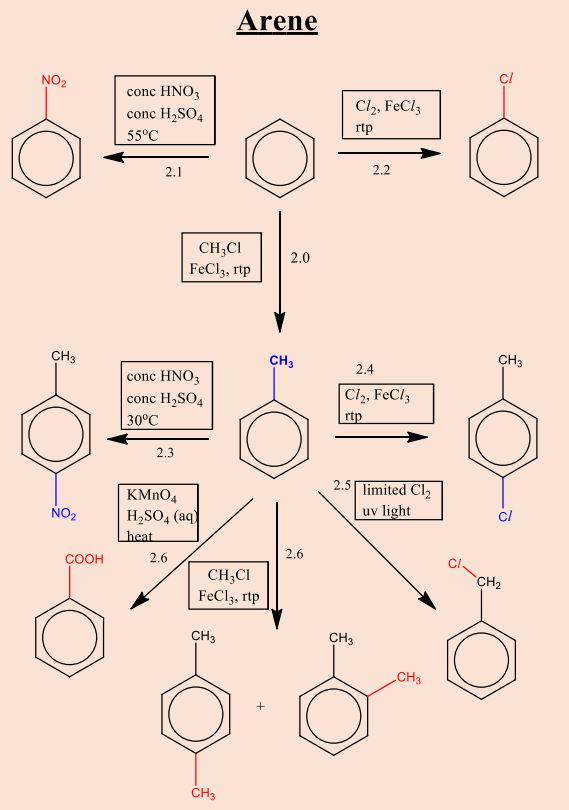
Arenes are a fascinating class of organic compounds that students studying H2 Chemistry should explore. These compounds contain one or more aromatic rings, characterized by their stable structure and unique properties. The most common example is toluene, which consists of a benzene ring with a methyl group attached.
One of the key properties is their aromaticity. This feature gives arenes special stability due to the delocalization of electrons within the ring structure. This stability makes it less reactive than alkenes, but they do undergo specific reactions.
Arenes primarily participate in electrophilic substitution reactions. In these reactions, an electrophile replaces a hydrogen atom on the aromatic ring. For example, when toluene reacts with bromine in the presence of a catalyst, bromine replaces one of the hydrogen atoms, forming bromotoluene. This reaction showcases the characteristic reactivity of arenes.
Another notable reaction is nitration, where arenes react with a mixture of concentrated nitric and sulfuric acids. This process introduces a nitro group into the aromatic ring, resulting in nitroaromatic compounds. Such reactions have practical applications in the synthesis of explosives and dyes.
Arenes are significant in various industries. Toluene, for example, is widely used as a solvent in paints, coatings, and adhesives. It also plays a crucial role in the production of chemicals like benzene and xylene.
In conclusion, arenes are essential compounds in organic chemistry. Their unique properties and participation in specific reactions make them important for students in H2 Chemistry to understand. By exploring this functional group, students can appreciate their relevance in both academic and real-world contexts.
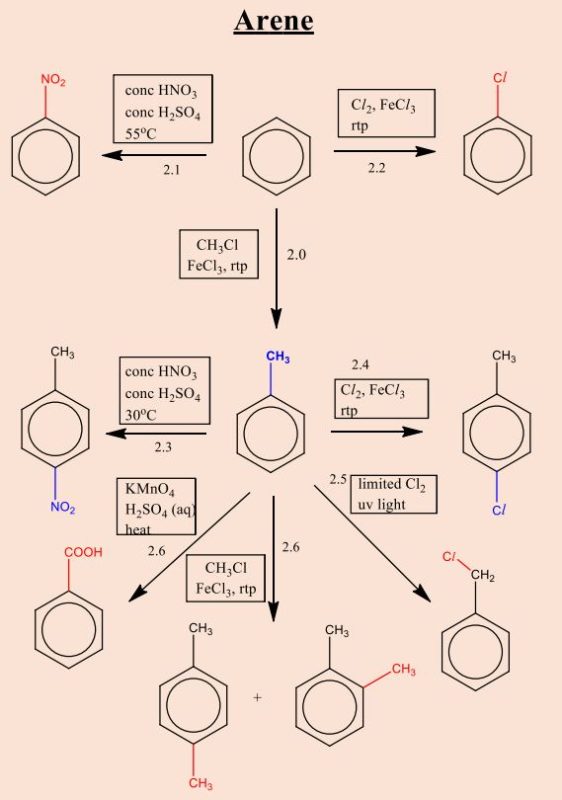
Feel free to download and print this out for your practice.
Click below for other functional groups in H2 Chemistry Syllabus: